SE920
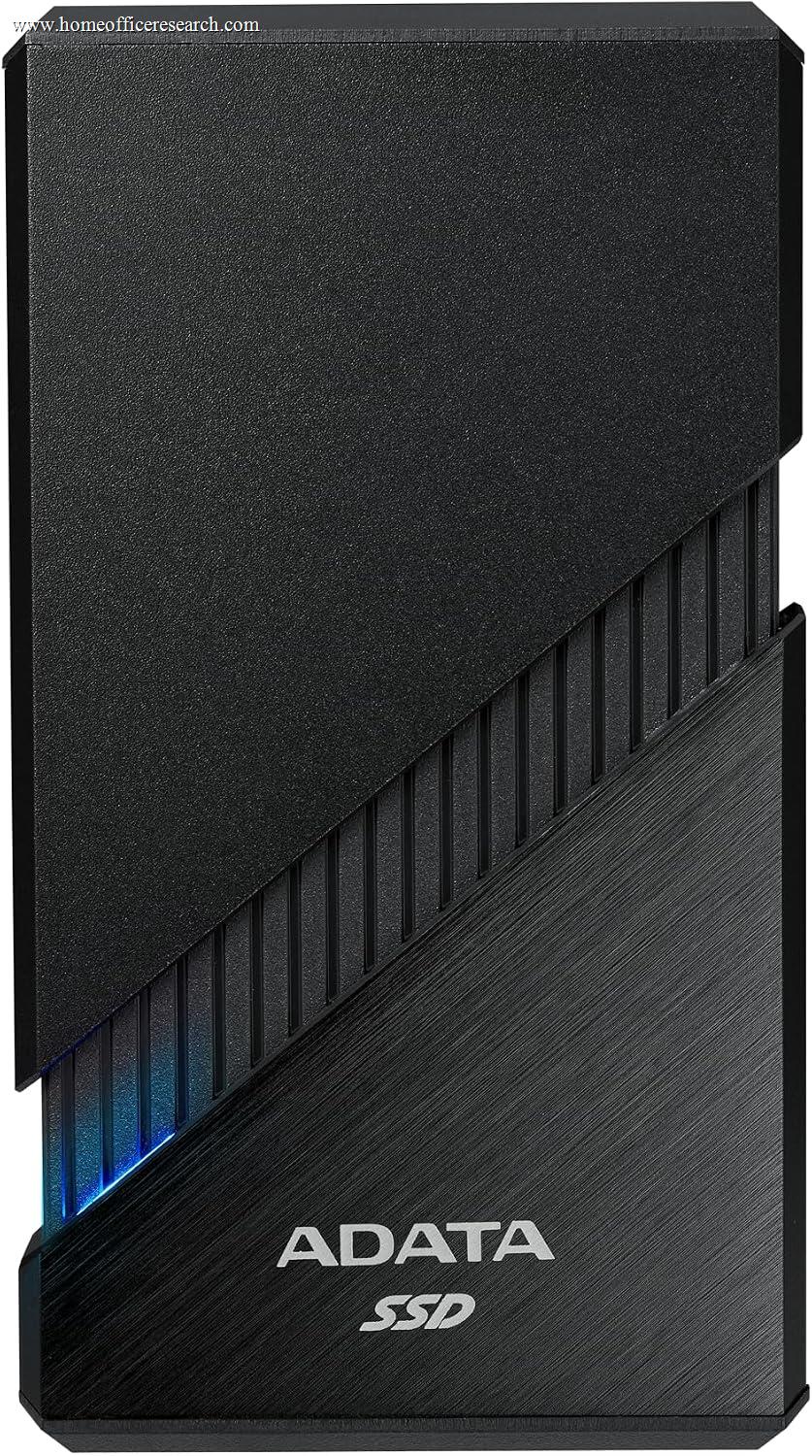
The ADATA SE920 is the cheapest way into USB4 — and the rare 40 Gbps drive built to keep its speed. Over a USB4 port it hits ~3,800 MB/s read and ~3,700 MB/s write, and a clever spring-loaded shell slides out to switch on a built-in micro-fan, so it sustains long transfers where fanless rivals throttle. It’s broadly compatible too, running across USB4, Thunderbolt 4/3, and standard USB 3.2. At 7.7 it earns Best 40 Gbps Value: you give up an IP rating and hardware encryption, and the fan and slider add moving parts the sealed pro drives don’t have. But if you want true USB4 speed without paying Thunderbolt-5 prices, nothing here gets you there cheaper.
How We Scored It
Category Deep-Dives
Real-World Performance
8.5 / 10 25% weightingThe SE920’s headline is raw USB4 speed. Over a 40 Gbps USB4 port it delivers up to 3,800 MB/s read and 3,700 MB/s write — roughly double the fastest 20 Gbps drives, and at launch reviewers called it the fastest external storage they had tested. For pulling high-resolution footage off a card, editing a project library directly from the drive, or moving tens of gigabytes at a time, that speed is the whole point.
Just as important, it sustains. Fanless USB4 drives tend to heat up and throttle partway through a long write; the SE920’s spring-loaded shell slides out to switch on a built-in micro-fan that holds IC temperatures down and keeps writes composed through extended transfers. The only reason it isn’t scored higher is that the Thunderbolt 5 drives above it — the OWC Envoy Ultra and LaCie Rugged SSD Pro5 — push past 6,000 MB/s, but they cost far more and need a TB5 host.
Bottom line on performance: ~3,800 MB/s over USB4, and an active fan keeps it from throttling on long transfers — among the fastest non-Thunderbolt-5 drives you can buy.
Reliability & Endurance
7.5 / 10 25% weightingADATA backs the SE920 with a five-year limited warranty and the usual flash protections — ECC and wear-leveling — and the active cooling is itself a reliability asset: heat is the enemy of both sustained performance and long-term endurance, and keeping the controller cooler helps on both fronts.
What holds the score to 7.5 rather than higher is the moving parts. The sliding shell mechanism and the micro-fan are components that the sealed, fanless pro drives in this tier simply don’t have, and any moving part is one more thing that can eventually wear, collect grit, or fail. ADATA is also a smaller storage name than vertically integrated rivals like Micron/Crucial or Samsung, which we weigh modestly. There’s no specific defect history here — but the universal rule still applies: keep a second copy of anything you can’t afford to lose.
Bottom line on reliability: A five-year warranty and fan-assisted cooling are real positives; the fan and slider mechanism are extra moving parts that keep it just shy of the sealed pro drives.
Durability & Build
6.0 / 10 15% weightingThis is the SE920’s softest physical area. There is no IP rating at all — no certified dust or water ingress protection — so it’s strictly an indoor desk-and-bag drive, not one for the job site or the field. The aluminum construction feels solid in hand, but the drive’s defining feature works against it here: the sliding fan shell is an opening in the enclosure and a mechanism that can collect dust or jam over time.
Against the rugged drives elsewhere in our rankings — the IP68, crush-rated LaCie Rugged SSD Pro5, or the IP65 everyday drives like the Samsung T7 Shield — this is a clear step down, which is why Durability lands at 6.0 (amber). Treat the SE920 as a fast desktop and travel drive that rides in a padded bag, not as something to drop on concrete or leave out in the rain.
Bottom line on durability: No IP rating and a moving fan shell make this an indoor/travel drive, not a rugged one — handle it with normal care.
Connectivity & Compatibility
8.5 / 10 15% weightingCompatibility is a genuine strength. The SE920 connects over USB-C and speaks USB4 (40 Gbps), and it’s backward-compatible across Thunderbolt 4 and Thunderbolt 3 (up to ~3,200 MB/s) and standard USB 3.2/2.0. That means it plugs into virtually any modern USB-C machine — Mac or PC — and simply runs at the fastest speed the host port supports.
This is where USB4 has a real edge over the 20 Gbps Gen 2×2 drives: Intel never built Gen 2×2 into its chipsets, so many laptops can’t drive those at full speed, whereas USB4 is the broad modern standard that’s increasingly built into new machines and is the foundation of Thunderbolt 4. ADATA includes a USB-C–to–C cable. Match it to a USB4 or Thunderbolt port for the full benefit; on an older port it falls back gracefully to that port’s top speed.
Bottom line on connectivity: USB4 plus Thunderbolt 4/3 and USB 3.2 fallback makes it broadly compatible across almost any modern USB-C laptop — Mac or PC.
Value
8.0 / 10 15% weightingValue is the SE920’s whole pitch, and the basis for its Best 40 Gbps Value badge. It is consistently the cheapest route into USB4, undercutting the Thunderbolt drives that cost dramatically more for similar — or only somewhat higher — real-world speed. For a creator who needs to move large media libraries quickly but can’t justify a Thunderbolt 5 drive, the SE920 delivers most of that experience at a fraction of the price.
Offered in 1, 2, and 4 TB, it’s the pick for anyone who wants true 40 Gbps performance on a budget rather than top-of-chart Thunderbolt 5 numbers. (We don’t print prices here because they change constantly — but undercutting the 40 Gbps field is precisely the SE920’s reason for being, so check the current Amazon price before buying.)
Bottom line on value: The cheapest way into real USB4 speed — most of the Thunderbolt experience for far less, which is exactly why it’s our Best 40 Gbps Value.
Software & Security
5.5 / 10 5% weightingThe SE920 is bare-bones here. There’s no built-in hardware encryption with a self-contained password lock, and no real management suite — security is left to your operating system’s BitLocker To Go (Windows) or FileVault (macOS), and there’s little bundled software beyond the basics. That’s fine for most people, who encrypt and back up with their own tools regardless.
But it’s a notch below drives that build in AES-256 hardware encryption with a password lock — like the Samsung T9 or WD My Passport — where security travels with the drive rather than depending on the host OS. This category carries only 5% weight, so it barely moves the total, but if a built-in hardware password lock matters to you, the SE920 isn’t the drive for it.
Bottom line on software & security: No hardware encryption and minimal software — lean on BitLocker or FileVault. Lightly weighted, but the SE920’s softest spot.
About the Manufacturer
ADATA Technology is a major Taiwanese memory and storage maker — one of the largest producers of DRAM modules and flash products in the world — with a well-known gaming sub-brand, XPG. It buys NAND rather than fabricating its own, which is one reason its drives often undercut vertically integrated rivals like Micron/Crucial and Samsung on price.
The SE920 is ADATA’s portable flagship: the first in its line to adopt USB4, and the showcase for its signature sliding active-cooling fan. It targets creators and gamers who want top-tier external speed without paying Thunderbolt-5 prices.
For buyers, ADATA’s appeal is aggressive pricing and a willingness to push new interfaces early. The tradeoffs are a smaller reliability track record than the very biggest names and, on the SE920 specifically, a feature-light software and security package.