V1
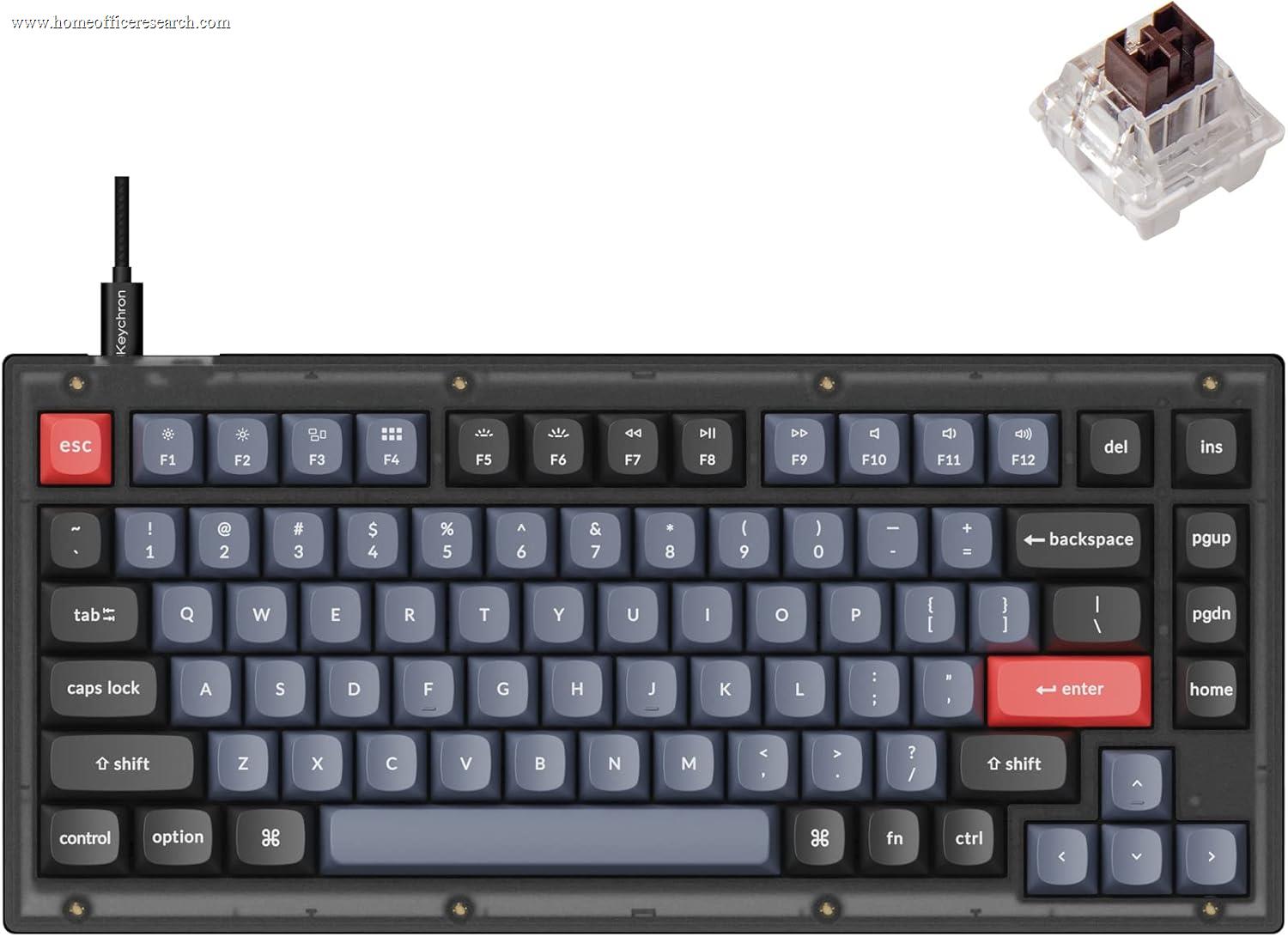
The Keychron V1 is a wired-only 75% mechanical keyboard with a hot-swap PCB and QMK/VIA firmware at a mid-budget price — the lowest-cost entry point in our evaluation for enthusiast-grade features. It brings the same 5-pin hot-swap socket, double-shot PBT keycaps, and open-source firmware customizability found in significantly more expensive keyboards, packaged in a plastic-bottom case without wireless connectivity. For buyers whose desks are cable-friendly and whose primary goal is getting into hot-swap mechanical territory at minimum cost, the V1 is a rational purchase. For anyone who works across multiple devices or needs a cable-free setup, the K8 Pro adds wireless for a modest step up in price.
How We Scored It
Category Deep-Dives
Typing Feel & Comfort
7.0 / 10 30% weightingThe V1’s typing experience is governed by its tray-mount construction and Gateron G Pro switch selection. Unlike the gasket-mount isolation found in the Q1 Pro, the V1’s plate-and-PCB assembly is screwed down onto standoffs in the bottom case — a rigid coupling that transmits switch vibration directly into the chassis without the damping cushion of compressible gaskets. The effect is audible and tactile: keystrokes land with a firmer, harder bottom-out sensation that enthusiasts typically describe as “clacky” rather than the “thocky” character of gasket keyboards. Tray mount is the most basic and most affordable mounting style, so this is less a flaw than the defining physical character of a board built to this price, and buyers evaluating the V1 against similarly priced boards will find its typing feel competitive within that group.
The Gateron G Pro switches are available in Red (linear, 45g), Brown (tactile, 55g), and Blue (clicky, 60g) variants at purchase. Red and Brown are the appropriate choices for home office use — Blue switches are too loud for video calls or shared spaces and score poorly on the acoustics category. Gateron G Pro switches are factory-lubed and provide smooth, consistent travel across the board, which is meaningful at this price: budget keyboards historically shipped with inconsistent or unlubed switches that required user preparation to feel acceptable. The V1 ships ready to use without modification, which lowers the barrier for buyers entering the mechanical keyboard space for the first time.
The double-shot PBT keycaps are a highlight at this price point. PBT is harder and denser than the ABS plastic used on most budget keyboards, producing a crisper sound and a more durable surface that resists shine from prolonged contact with fingertips. The double-shot manufacturing process makes legends a physical part of the keycap structure, meaning they cannot fade regardless of use. Getting double-shot PBT on a keyboard at this price is genuinely unusual — most competitors at this price ship either ABS with pad-printed legends or thin PBT with laser-etched legends that will eventually wear. The V1’s keycaps are a legitimate long-term material, not a cost-cutting compromise.
Bottom line on typing feel: Solid mechanical typing with good switch factory lubrication and durable PBT keycaps — constrained by tray-mount rigidity that limits the acoustic refinement ceiling compared to gasket-mount keyboards. The 7.0 score reflects a keyboard that types better than its price suggests, but not better than its mount type permits.
Build Quality
7.0 / 10 20% weightingThe V1 uses an aluminum alloy top frame with a plastic bottom case — a hybrid construction that places the more rigid material where fingers interact with the keyboard (the top surface and switch plate) while cutting cost on the less visible base. The aluminum top frame contributes meaningful rigidity: pressing on the key surface produces no flex, and the overall chassis feels substantially more solid than an all-plastic keyboard of the same dimensions. However, the plastic bottom case does transmit more resonance to the desk surface than a full-metal chassis, and the weight of approximately 900g (without cable) is noticeably lighter than the Q1 Pro’s ~1.3kg. The difference matters acoustically — a heavier case absorbs more vibration — but at this price, the hybrid construction is a defensible compromise.
The 5-pin hot-swap PCB is the V1’s most significant long-term advantage over similarly priced boards without hot-swap. Hot-swap sockets allow individual switches to be removed and replaced without soldering — a process that takes under a minute per switch with a basic switch puller. For a buyer who wants to try multiple switch types before committing, or who wants to replace a failed switch without returning the entire keyboard, this is a concrete practical benefit. The 5-pin socket compatibility accepts both 3-pin and 5-pin switches, which covers the full range of popular aftermarket switch options from Gateron, Cherry, Akko, and others at various price and feel points.
The stabilizers on the V1’s wider keys (spacebar, backspace, shift, enter) are functional but represent a lower preparation level than the Q1 Pro. Factory lubrication is present but thinner than ideal, which produces some rattle on the spacebar under hard presses for a portion of units. This is correctable in under 20 minutes with basic stabilizer lubrication — a well-documented modification that the QMK community has written extensively about — but it requires user intervention that buyers of premium keyboards do not face. For buyers unwilling to perform this modification, the spacebar rattle is present but not severe enough to be a dealbreaker in normal typing use.
Bottom line on build quality: Aluminum-top hybrid construction with a 5-pin hot-swap PCB gives the V1 a material and serviceability story that exceeds its price. The 7.0 score is honest about the plastic base and stabilizer preparation gap relative to the Q1 Pro, while acknowledging that nothing at this price offers comparable hot-swap capability.
Connectivity & Features
5.5 / 10 20% weightingThe V1 is wired-only via USB-C, with no Bluetooth, no 2.4GHz receiver, and no multi-device pairing. In a category where Bluetooth 5.1 has become standard at the next price tier up (Keychron’s own K8 Pro), the complete absence of wireless connectivity is the V1’s most significant functional limitation. For buyers who work exclusively on a single desktop and never need to switch input between a laptop, phone, or tablet, wired-only is a non-issue — zero-latency, always-connected, no battery management required. For anyone whose workflow involves switching between devices — a common pattern in hybrid work setups that combine a laptop with an external monitor — the V1’s wired-only design creates friction that the K8 Pro eliminates for a modest additional cost.
The USB-C connection is a genuine improvement over the older Micro-USB ports found on earlier Keychron V-series and K-series keyboards. USB-C cables are widely available, interchangeable with charging cables for phones and laptops, and durable under daily plugging and unplugging. The V1 ships with a braided USB-C to USB-A cable that is more aesthetically appropriate for a desk setup than the basic rubber cables shipped with most budget keyboards. The QMK/VIA firmware — while covered in detail under Customizability — is also worth noting as a connectivity-adjacent feature: VIA remapping works over the USB-C connection and does not require any software installation, which reduces the setup friction for new users.
No additional features — no programmable knob, no USB passthrough hub, no dedicated media controls beyond QMK layer mapping — are present. At this price, this is expected and appropriate rather than a failing. The feature set is exactly the hardware necessary to deliver the hot-swap and QMK promise without inflating cost.
Bottom line on connectivity: Wired USB-C only — functional and reliable, but a limiting constraint for multi-device workflows that are increasingly common in home office setups. The 5.5 score reflects that this limitation is real and binary: either wired-only works for your setup or it does not. If it does not, the pricier K8 Pro resolves the constraint with Bluetooth 5.1 and 3-device pairing.
Acoustics & Workspace Fit
6.5 / 10 15% weightingThe V1’s acoustic profile is shaped primarily by its rigid tray-mount plate. Keychron does include a layer of sound-absorbing foam in the case, which tames the hollow resonance a bare plastic bottom would otherwise produce — but it does not change the firm, clacky character created by the rigid mount and full-travel switches. Typing at normal speed produces an audible mechanical clack — approximately 58–65 dB SPL with Red switches, closer to 65–70 dB with Brown tactile or Blue clicky. These levels are audible on a directional microphone placed 60cm from the keyboard during a video call, which means the V1 is a marginal choice for users who type frequently during calls without a headset with a close-position boom microphone. In a solo home office environment with no active calls, the V1’s noise level is unremarkable — louder than a laptop keyboard but not disruptive in any practical sense.
The 75% layout is genuinely well-suited to home office use in terms of desk footprint. By eliminating the numpad and tightening the navigation cluster, the V1 reduces total board width to approximately 320mm — freeing desk space to the right of the keyboard that a tenkeyless or full-size board occupies. The 75% layout retains dedicated arrow keys and a compressed home/end/page cluster, which means the most common navigation shortcuts remain directly accessible without requiring layer switching. This is a practical advantage over 65% layouts (which require layer access for arrows) and 60% layouts (which eliminate the function row entirely), making the 75% form factor a reasonable default for knowledge workers who primarily use spreadsheets, code editors, or document applications.
Beyond the factory foam, community-documented modifications can refine the V1’s acoustics further without voiding any warranty or requiring irreversible changes. A PE-foam or “Tempest” mod (a thin sheet placed between the switches and the PCB) tightens the typing sound and trims any residual hollowness; stabilizer lubrication eliminates spacebar rattle; switch film installation reduces switch wobble. None of these modifications require soldering, and all are reversible. For buyers willing to invest 30–60 minutes in preparation, the V1’s acoustic floor drops further below its already-dampened out-of-box state.
Bottom line on acoustics: Standard mechanical noise characteristics with a tray-mount-rigid acoustic profile — louder than scissor-switch alternatives and marginal for video-call use without microphone management. The 75% footprint is an asset. The 6.5 score reflects honest mechanical keyboard acoustics at an entry price point, with meaningful improvement available via basic DIY modification.
Value
8.0 / 10 10% weightingAt its mid-budget price, the Keychron V1 is the most affordable keyboard in our evaluation to include hot-swap PCB, QMK/VIA firmware, and double-shot PBT keycaps simultaneously. Each of these features individually commands a price premium on most keyboards; finding all three in a single board at this price is the V1’s primary value proposition. The closest wired competition — budget mechanicals from brands like Epomaker, Akko, or Royal Kludge — offers hot-swap at comparable prices but inconsistently includes QMK/VIA support and double-shot PBT. Keychron’s V series consolidated this feature set at a price point where trade-offs are normally required.
The long-term cost picture favors the V1 over non-serviceable keyboards in the same price bracket. Hot-swap replaceability means that when a switch fails or wears, the affected switch can be replaced for pennies rather than requiring full board replacement. QMK/VIA firmware support extends the keyboard’s functional life beyond Keychron’s commercial support window — the open-source community maintains QMK firmware indefinitely for keyboards that achieve a critical user base, and the V1 has achieved that base. The double-shot PBT keycaps will not wear visibly over a multi-year ownership period. These are the material characteristics of a keyboard designed to last, not to be replaced on a 2–3 year consumer electronics cycle.
Bottom line on value: The strongest value proposition in our keyboard evaluation on a per-feature basis — hot-swap, QMK/VIA, and double-shot PBT at this price is a combination that costs meaningfully more on most competing boards. The 8.0 score reflects this objectively, tempered slightly by the wired-only limitation that makes the K8 Pro the better overall purchase for most buyers despite its higher price.
Customizability
9.0 / 10 5% weightingThe V1’s QMK/VIA firmware support places its customizability at the same level as keyboards costing two to three times as much. QMK enables complete key remapping, multi-layer configuration, macro programming at any key, tap-dance functionality (where a single key performs different actions based on tap count or hold duration), and custom RGB animations programmed at the individual LED level. VIA provides a graphical interface for most of these functions that operates in-browser without software installation and applies changes instantly via USB. For users with specialized workflows — developers who need specific key combinations, writers who want macro shortcuts, spreadsheet users who want to remap navigation keys — this level of programmability is functionally unavailable on non-QMK keyboards regardless of price.
The 5-pin hot-swap PCB makes the V1 a long-term platform rather than a fixed product. Any MX-footprint switch in the market — tactile, linear, clicky, silent, heavy, light — can be installed without tools beyond a switch puller. Popular switch upgrades at various budget levels include Gateron Yellow Silent (reducing noise to near-scissor-switch levels), Boba U4 (high-quality tactile with minimal noise), or Gateron Oil King (smooth linear with a premium feel), each available for a few cents per switch. The ability to change the entire feel of the keyboard for the cost of a set of switches is a customizability advantage unavailable on soldered keyboards at any price.
Standard MX-footprint compatibility also opens access to the full aftermarket keycap ecosystem — including sets from Domikey, ePBT, Infinikey, and the broader group-buy market — in any profile (Cherry, OEM, SA, MT3, KAT), material, or colorway the user prefers. The V1’s layout is a standard 75% arrangement with no unusual key sizes that would create keycap compatibility gaps, which makes it an easy target for full aftermarket keycap sets.
Bottom line on customizability: QMK/VIA firmware plus 5-pin hot-swap is the maximum customizability specification available in the mechanical keyboard market, matched only by the Q1 Pro and K8 Pro in our evaluation. The 9.0 score (vs. Q1 Pro’s 9.5) reflects a minor gap in stabilizer serviceability and case mod accessibility, not any difference in firmware or switch capabilities.
About the Manufacturer
chron
Keychron was founded in 2017 with a focus on bringing enthusiast mechanical keyboard features — hot-swap PCBs, QMK firmware, aluminum construction — to the mainstream market at accessible price points. The company established itself with the K-series (wireless, aluminum frame, Mac-compatible) before launching the V-series as a wired-only line that traded wireless connectivity for lower prices and included QMK/VIA support by default. The V-series represents Keychron’s answer to the custom keyboard community’s demand for entry-level QMK-compatible boards.
The V1 launched in 2022 as the first entry in the V-series, targeting buyers who wanted the firmware flexibility of custom keyboards without the premium price tag associated with enthusiast alternatives. Keychron publishes open-source QMK firmware repositories for all V-series keyboards on GitHub, ensuring continued community firmware support independent of Keychron’s commercial product lifecycle. This is consistent with Keychron’s broader approach to the enthusiast community: transparent specifications, open-source firmware, and hardware designed to be modified rather than treated as a sealed consumer appliance.
Keychron’s V-series has since expanded to V2, V3, V4, and V5 covering different layout sizes (65%, 75%, TKL, 96%, full-size), all sharing the same QMK/VIA, hot-swap, and aluminum-top construction philosophy. The V-series collectively represents the most accessible entry point into enthusiast-grade mechanical keyboards from a major keyboard brand.