Gesture
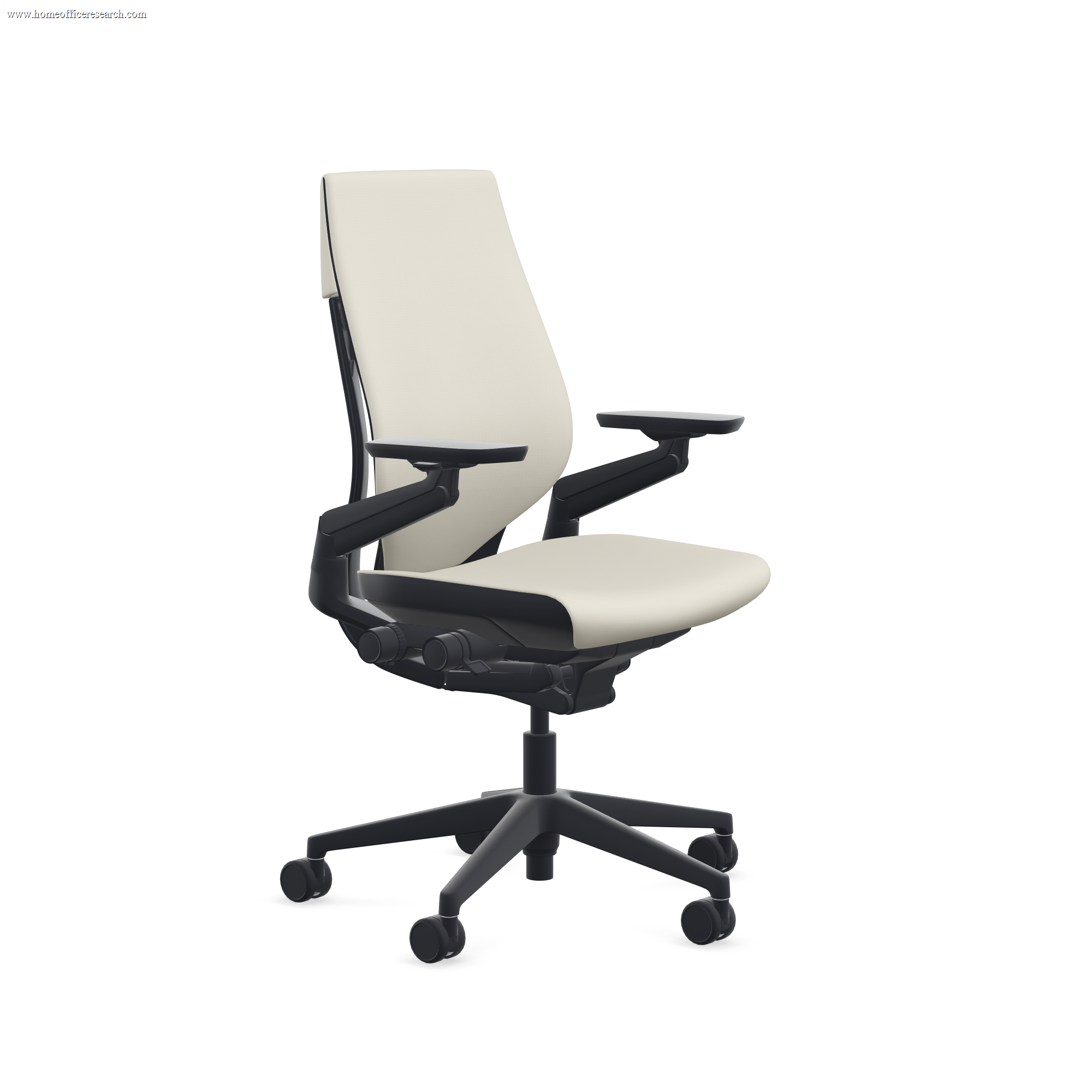
The Gesture holds our top overall ranking by solving a problem most chairs ignore: the arm positions and body postures that come with modern multi-device computing. Its 360° arm system is unlike anything else we’ve tested, and its ergonomic fundamentals are as strong as any chair at any price.
How We Scored It
Category Deep-Dives
Ergonomics & Support
9.2 / 10 30% weightingThe Gesture was designed around a specific observation: Steelcase’s workplace researchers documented workers spending increasing time in postures that conventional chairs weren’t built for — hunching over smartphones, reaching across to touchscreens, sitting sideways. The response wasn’t just a new lumbar mechanism but a complete rethinking of how the chair’s arms, back, and seat interact with the user across all of those positions.
The Core Equalizer lumbar system consists of two independent pads that move both vertically and laterally, adapting to the user’s movement rather than holding a fixed position. Where many chairs provide a single lumbar pad that supports one point on the spine, the Core Equalizer distributes contact across the lumbar curve as the user shifts. An optional add-on provides explicit height and pressure adjustment for users who want more direct control.
The backrest uses a LiveBack-inspired flex mechanism: it changes shape as the user moves, rather than pivoting as a rigid unit. In practice, this means the back follows the natural curvature change that happens as you lean forward toward a screen or recline away from it. The seat’s Natural Glide System moves the seat pan forward and slightly downward as the user reclines, maintaining a consistent relationship between pelvis and lumbar support throughout the recline range — this is a more sophisticated mechanism than a standard recline pivot, and it’s one of the features that distinguishes the Gesture (and the Leap V2) from chairs that simply tilt backward.
The 9.2 reflects the Gesture’s genuine strength here, with a marginal deduction for the Core Equalizer not being quite as immediately intuitive or as dynamically adaptive as the Haworth Fern’s Wave Suspension System, which needs no explicit adjustment at all.
Bottom line on ergonomics: Among the strongest in the category. The combination of the adaptive back and the Natural Glide seat system provides thorough spinal support through a wider range of postures than most competing chairs.
Comfort & Materials
8.5 / 10 25% weightingThe Gesture uses a foam-padded back cushion rather than mesh — a deliberate choice that produces a distinctly different comfort profile. The initial feel is softer and more immediately cushioned than mesh alternatives. Steelcase uses high-density foam that independent long-term reviews consistently confirm resists compression well; the same chair at five or eight years of daily use continues to feel substantially similar to new. This is not a given at any price point — budget and even some mid-range chairs show measurable foam compression within the first year.
The tradeoff is breathability. Fabric-over-foam backs retain more heat than mesh. In warm offices or during warm seasons, users of the Gesture will notice more heat buildup against the back than they would in an Aeron or a Haworth Fern. If your home office is temperature-controlled and climate is not a concern, this is minor. If you run warm or work in a space that heats up during the day, it’s worth factoring in seriously — enough that we’d direct some users specifically toward the Aeron instead.
The seat uses a waterfall edge design with a forward tilt feature that reduces pressure on the back of the thighs. The seat foam is notably well-reviewed in long-term ownership reports, with consistent mention of comfort across sessions of six or more hours. The Gesture is also available in multiple fabric finishes and colorways, as well as leather options, allowing it to integrate into different home office aesthetics.
Bottom line on comfort: Excellent foam quality and a comfortable seat system. The foam back is warmer than mesh — a real consideration in warm environments. Not a weakness overall, but the deciding factor for buyers choosing between the Gesture and the Aeron.
Value for Money
8.0 / 10 20% weightingThe Gesture is expensive at new retail by any casual measure. The value case rests on two foundations: amortized cost and the refurbished market. Spread across the 12-year warranty period and 6–8 hours of daily use, the annual cost compares favorably to other recurring expenses most people don’t think twice about.
The stronger argument is the Steelcase-certified refurbished market. Dealers like Crandall Office offer professionally refurbished Gesture chairs — reupholstered, with replaced cylinders and castors, cleaned and inspected — with full 12-year warranties at a significant discount to new retail. A certified refurb with a fresh 12-year warranty represents genuinely excellent value for a chair with the Gesture’s specification level and documented longevity track record.
New pricing at full retail is harder to defend purely on numbers when alternatives like the Steelcase Leap V2 or the Eurotech Vera deliver capable ergonomics at significantly lower cost. The Gesture’s 8.0 here reflects strong value at the refurb price point, diluted somewhat by the new-retail figure relative to competitors.
One note: the Gesture’s Wirecutter #1 ranking, sustained across nearly a decade and multiple rounds of testing, represents unusually strong independent validation and contributes to its resale value — the chair holds value better than most at resale.
Bottom line on value: Expensive at full retail, but the certified refurb market transforms the value equation significantly. Evaluate on a cost-per-year basis, not sticker price.
Build Quality & Longevity
9.5 / 10 15% weightingSteelcase manufactures the majority of Gesture components in-house or through closely managed supply relationships — a structural advantage over brands that assemble chairs from commodity components. The frame uses glass-filled nylon, which balances strength with weight reduction. The pneumatic cylinder is full commercial grade. The castors are dual-wheel casters rated for hard floors and carpet, not the lightweight single nylon wheels that fail predictably on budget chairs.
The 12-year warranty covers all mechanical components, the cylinder, the base, the foam, and the upholstery (5 years on foam and fabric is standard; the full 12-year mechanical coverage is comprehensive). Steelcase honors warranty claims through its dealer network reliably — this is documented extensively in long-term owner communities, which is meaningful because a warranty is only as valuable as the likelihood it will be honored.
The mechanism assembly on the Gesture is noticeably solid — levers and adjustments feel precise and positive without play. This matters for long-term use: loose adjustment mechanisms that fail to hold set positions are one of the most common failure modes in mid-range and budget chairs. The Gesture shows no sign of this tendency under extended use.
Bottom line on build: Among the highest build quality of any chair we’ve tested. The 12-year warranty is backed by a real track record, not just a marketing promise.
Adjustability Range
10.0 / 10 7% weightingThe Gesture receives a 10.0 in this category — the only chair in our guide to do so — because it has the most comprehensive adjustment set of any chair we’ve evaluated, with one feature that no competitor matches at any price: the 360° arm system.
Standard high-end chairs offer 4D arms: height, width, fore-aft, and rotation. The Gesture’s arms rotate continuously through all three axes simultaneously. They can move forward to support a user holding a tablet, swing outward to accommodate a wider desk position, rotate inward for keyboard work, or hold any intermediate position. In practice, this matters most for users who regularly switch between a keyboard, a phone, and a secondary touchscreen — exactly the working pattern Steelcase observed and designed for.
Beyond the arms, the full adjustment inventory includes: seat height, seat depth adjustment (a critical feature for users outside the average height range), back angle, recline tension control, recline lock (with multiple positions), and a forward tilt option. A headrest is available as an aftermarket add-on from third-party suppliers, though not natively from Steelcase — a minor gap worth noting for users who want head support.
Bottom line on adjustability: The most adjustable chair we’ve tested. The 360° arm system is a genuine differentiator with practical implications, not a marketing specification.
Aesthetics & Footprint
8.0 / 10 3% weightingThe Gesture’s visual profile is clean and professional — understated compared to the Aeron’s iconic silhouette or the Haworth Fern’s organic frond design. It presents as a well-made task chair without strong visual identity, which is appropriate for most home offices. Multiple fabric colorways (grays, blues, blacks) and leather finishes are available, providing flexibility across different workspace aesthetics.
The base diameter is approximately 26 inches, which is standard for this class of chair — not unusually large, though worth measuring against your workspace before purchasing. The overall profile is compact for a chair with this level of mechanism complexity.
Bottom line on aesthetics: Functional and professional rather than visually distinctive. Not a weakness, but not a reason to choose the Gesture over alternatives either.
About the Manufacturer
case
Steelcase was founded in 1912 as a steel office furniture manufacturer in Grand Rapids, Michigan, and has grown into one of the three largest office furniture companies in the world. It went public on the NYSE in 1998 and employs approximately 13,000 people globally. Grand Rapids remains its headquarters and a center of its manufacturing operations.
What distinguishes Steelcase at a research level is its WorkSpace Futures group — an internal research function that has published extensively on posture, workplace behavior, and the ergonomic implications of changing computing patterns. The Gesture emerged directly from this research: Steelcase documented over 2,000 hours of worker behavior observations across multiple countries before beginning the design process, identifying 9 distinct body postures that modern workers adopt — and noting that most existing chairs accommodated only a subset of them.
Steelcase products are sold through a network of certified dealers and through Amazon. The certified refurbished market for Steelcase chairs is well-developed, with dealers like Crandall Office Furniture offering remanufactured Gesture and Leap V2 chairs with fresh 12-year warranties. This dealer infrastructure is a meaningful long-term ownership advantage: parts availability, repair support, and warranty service are not dependent on the manufacturer’s direct-to-consumer support.