364 USB-C Hub (10-in-1)
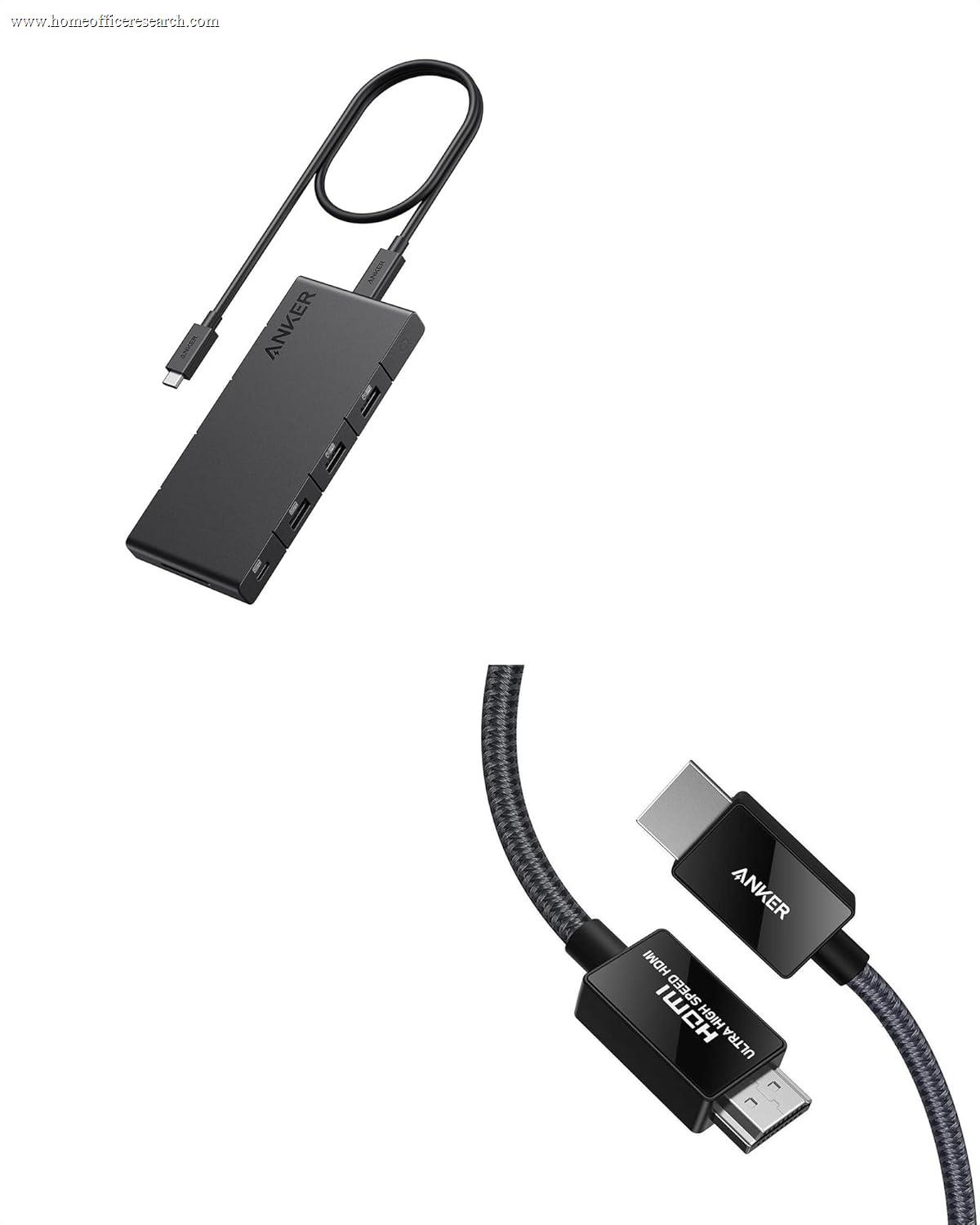
The Anker 364 is a 10-in-1 USB-C hub with two HDMI outputs — a headline feature that sounds attractive until you read the fine print: running both displays simultaneously caps each at 4K@30Hz, delivering the same choppy motion artifacts that define our lowest display scores in this guide. Use just one display and you can reach 4K@60Hz, but buying a dual-HDMI hub implies you want dual monitors, and that use case is limited to 30Hz per screen. The power delivery situation adds a second complication: the advertised 85W charging requires a separate 100W USB-C adapter plugged into the hub’s dedicated PD-IN port — a second charger most buyers won’t have or won’t think to add. Without that adapter, the hub is bus-powered at roughly 65W. Of the hub’s three USB-A ports, two operate at USB 2.0 speed (480Mbps) — barely faster than the standard from 2000 — leaving just one USB-A port at a useful 5Gbps data rate. The Anker 552 is a better-considered hub at the same tier; the Anker 565 eliminates the dual-display 30Hz problem entirely at a modest premium.
How We Scored It
Category Deep-Dives
Connectivity & Bandwidth
3.0 / 10 30% weightingThe Anker 364 connects to the host via USB-C Alt Mode, sharing a 10Gbps bandwidth ceiling across all connected devices. This is the same connection protocol used by the Anker 552 and 565 above it in our rankings — but where the 552 drives a single display and the 565 drives two displays at 4K@60Hz via MST, the 364 attempts to drive two 4K@30Hz displays simultaneously from a 10Gbps Alt Mode connection. That is an extremely narrow bandwidth envelope: two simultaneous 4K@30Hz streams consume the majority of available bandwidth, leaving little headroom for USB data transfers or ethernet throughput. In practice, users running dual displays through the 364 will observe data transfer speeds significantly slower than the port specs suggest.
The bandwidth problem is structural, not incidental. Alt Mode over USB-C at 10Gbps was not designed for dual 4K output. The Anker 565 addresses this with HDMI 2.0 and careful chipset design optimized for dual-display Alt Mode output; the 364 does not achieve the same result, bottoming out at 4K@30Hz per display in dual mode. For single-display use, the bandwidth constraint is less severe and 4K@60Hz is achievable, but that does not justify buying a dual-HDMI hub.
The 3.0 connectivity score reflects the combination of the 10Gbps Alt Mode ceiling, the functional bandwidth ceiling under dual-display load, and the USB 2.0 speed on two of three USB-A ports (discussed in Port Mix). This is the weakest connectivity profile among USB-C hubs in our guide at this price tier.
Bottom line on connectivity and bandwidth: USB-C Alt Mode with 10Gbps shared bandwidth spread across two HDMI outputs, ethernet, and four USB data ports. Dual 4K display use consumes the bulk of available bandwidth, degrading data transfer performance to the remaining peripherals. The 3.0 score reflects a connectivity profile that is structurally limited for the dual-display use case the 364’s hardware implies.
Display Capability
3.5 / 10 25% weightingThe Anker 364 is marketed as a “Dual 4K HDMI” hub — a description that is technically accurate but practically misleading. Both HDMI ports are limited to 4K@30Hz when both displays are active simultaneously. Only when using a single display does the output reach 4K@60Hz. A buyer reading “Dual 4K HDMI” on the product listing and expecting to run two 4K@60Hz monitors will be disappointed; the second display immediately drops both outputs to 30Hz the moment it is connected.
The practical consequences of 4K@30Hz are identical to those discussed in our Anker 552 review: at 30Hz, all on-screen motion — scrolling web pages, dragging windows, playing video, cursor movement at speed — produces visible stutter. The display responds to input at half the cadence of a 60Hz panel, creating a perceptible latency between user action and screen update. For a single-monitor user, the 364 can avoid this problem by staying in single-display mode at 4K@60Hz. But a hub with two HDMI ports on the desk exists to drive two monitors, and the moment you do, both degrade to 30Hz.
The 3.5 display score is lower than the Anker 552’s 4.0 despite identical per-display refresh rates, because the 364 carries the additional penalty of a misleading dual-display marketing claim. The 552 does not present itself as a multi-monitor solution; the 364 does, and then cannot deliver the quality that claim implies. Users who need dual 4K@60Hz monitors should step up to the Anker 565, which achieves dual 4K@60Hz in single-cable mode on compatible laptops.
Bottom line on display capability: Two HDMI ports that are individually capable of 4K@60Hz but collectively limited to 4K@30Hz per display in dual-monitor mode. The “Dual 4K HDMI” marketing creates expectations the hardware cannot fulfill at 60Hz. The 3.5 score reflects a display specification that is better than no dual-display output but significantly below the standard expected from a hub explicitly positioned as a dual-monitor solution.
Power Delivery
4.5 / 10 20% weightingThe Anker 364’s power delivery situation requires more explanation than most hubs at this price tier. The hub has a dedicated PD-IN port that accepts up to 100W input and passes through up to 85W to the connected laptop. This sounds strong — and it would be, if that 100W input adapter were included in the box. It is not. The 364 ships without a power adapter. To receive the 85W pass-through charging, buyers must separately obtain a 100W USB-C PD charger and plug it into the hub’s PD-IN port.
Without the external 100W adapter connected, the 364 operates as a bus-powered hub, drawing all power from the laptop’s USB-C port. In this configuration — which is how most users will initially use the hub, simply by plugging USB-C cable from laptop to hub — the available charging wattage drops to roughly 65W and may be inconsistent under sustained load. For thin-and-light ultrabooks with 45W or lower charging requirements, bus-powered operation is adequate. For the 16-inch MacBook Pro (140W rated) or high-performance Windows laptops, 65W will result in slow or no net charging during demanding workloads.
The two-adapter workflow is a real usability friction point. The intent is that the user’s existing 100W USB-C charger plugs into the hub’s PD-IN, and the hub’s upstream cable plugs into the laptop — replacing the charger’s direct laptop connection with hub pass-through. This requires buyers to already own a 100W USB-C charger and to rewire their desk setup. The Anker 552’s 85W charging, by contrast, is delivered bus-powered without any additional hardware.
Bottom line on power delivery: 85W PD pass-through is available when a separately purchased 100W USB-C adapter is connected to the hub’s PD-IN port. Without that adapter, bus-powered operation delivers roughly 65W — adequate for ultrabooks, insufficient for high-performance laptops. The 4.5 score reflects the conditional nature of the 364’s best-case charging performance and the usability friction of the two-adapter setup.
Port Mix
3.0 / 10 15% weightingThe Anker 364 provides ten ports total, but the composition reveals a significant quality problem that the port count obscures: of the hub’s three USB-A data ports, two are USB 2.0 running at 480Mbps. Only one USB-A port operates at USB 3.2 Gen 1 speed (5Gbps). USB 2.0 at 480Mbps is adequate for keyboards, mice, and webcams — but plugging an external hard drive, a USB 3.0 flash drive, or any storage device into a USB 2.0 port means a maximum theoretical transfer rate of 60MB/s versus 625MB/s on a 5Gbps port. In practice, the 480Mbps ports will be a silent performance trap for users who do not check the spec sheet.
The port inventory: 2× HDMI outputs, 1× USB-C 5Gbps data, 1× USB-A 5Gbps, 2× USB-A 480Mbps (USB 2.0), 1× Gigabit Ethernet, 1× SD card slot (UHS-I), 1× PD-IN (100W in, 85W out), 1× upstream USB-C cable to host. The SD reader is single-slot only — no microSD reader — unlike the Anker 552 which includes both SD and microSD in separate slots. There is no audio jack, consistent with most compact hubs at this price tier but worth noting for users with wired headsets or desktop speakers.
The Gigabit Ethernet port is a genuine positive. Wired networking adds substantial reliability to a home office setup versus Wi-Fi, and its inclusion at this price tier separates the 364 from purely display-expansion hubs that omit it. However, this single positive does not offset the USB 2.0 penalty on two-thirds of the USB-A ports or the single-slot card reader limitation.
Bottom line on port mix: Ten ports on paper, but two of three USB-A ports run at USB 2.0 (480Mbps) — a specification that is easy to miss in the product listing and meaningful in daily use. Gigabit Ethernet is a genuine strength at this price. Single SD slot (no microSD), no audio jack. The 3.0 score reflects a port mix that underdelivers on usable high-speed connectivity relative to the port count headline.
Value
7.0 / 10 7% weightingThe Anker 364 is typically priced in budget territory for a dual-HDMI hub with ethernet. At this price, the combination of two HDMI outputs, Gigabit Ethernet, an SD card reader, and Anker’s warranty makes it one of the more feature-loaded hubs at the price. Comparable hubs with dual HDMI output frequently omit ethernet entirely; the 364’s inclusion of ethernet at this price is a genuine differentiator. Buyers who need a low-cost hub that adds wired networking and dual-screen capability to a laptop — and who can live with 4K@30Hz on both displays — will find the 364 honestly priced for what it offers.
The value score reflects the genuine price competitiveness honestly but accounts for the limitations that affect real-world utility. The 4K@30Hz dual-display ceiling and the USB 2.0 ports reduce the functional value below what the port count implies. For buyers comparing the 364 to the Anker 552 (similarly priced, same score bracket), the 552 delivers better per-port speed and cleaner power delivery. For buyers considering the step up to the Anker 565 — which runs dual displays at 4K@60Hz — the additional cost is justified if dual-display productivity is the primary use case. The 7.0 value score is the 364’s best result and reflects the price-to-feature-count ratio as genuinely competitive in its tier.
Bottom line on value: Strong price-to-feature-count ratio for buyers who need dual HDMI and ethernet at a budget price. The value proposition weakens for anyone who will frequently use both displays simultaneously or transfer files via USB-A. At its budget price, an honest option for occasional dual-screen use; the Anker 552 is a better choice for single-screen buyers at a similar price.
Build Quality
7.0 / 10 3% weightingThe Anker 364 uses a compact plastic housing consistent with Anker’s hub product line. The form factor is slightly larger than the Anker 552 to accommodate the additional HDMI port and PD-IN port, but remains desk-friendly and light enough for travel. Build quality control is above average for the price tier — port fitment is solid, the USB-C cable attached to the hub (on models with a captive cable) shows no signs of early stress failure in owner reports, and physical defects are rare in the category feedback for this model.
The hub runs warm under load, particularly when driving two displays simultaneously alongside ethernet and USB data — a reasonable thermal load for a plastic-housed bus-powered device. Anker’s 18-month warranty is standard for the brand and covers manufacturing defects. Anker’s warranty support has a strong reputation for straightforward claim processing. The 7.0 build quality score is slightly lower than the 552’s 7.5, reflecting the additional mechanical complexity of the PD-IN port and the minor added thermal load from the dual-display chipset, without a commensurate improvement in build premium or materials.
Bottom line on build quality: Typical Anker plastic construction — reliable, not premium, above average for the price. The 7.0 score correctly positions the 364 as better built than generic no-name alternatives at the same price and a step below aluminum-chassis docks at higher price points. The 18-month warranty is a meaningful backstop for daily use over a multi-year lifespan.
About the Manufacturer
ER
Anker is a consumer electronics brand based in Shenzhen, China, with significant US operations, known primarily for USB-C charging and connectivity accessories. Founded in 2011, the company built its reputation on USB charging products and expanded into hubs, cables, power banks, and audio. The 364 represents the entry level of Anker’s hub lineup — below the 552 (9-in-1, cleaner port mix), the 565 (11-in-1, dual 4K@60Hz capable), and the 778 Thunderbolt 4 dock (premium, full 40Gbps bandwidth) at the top of the range.
Anker’s consistent value proposition is reliable hardware at competitive prices, backed by a warranty support process that responds to claims without excessive friction. The 364 fits this model in terms of price and build quality, but sits at the bottom of the Anker hierarchy because its hardware compromises — the 4K@30Hz dual-display ceiling and the 480Mbps USB-A ports — reflect cost savings that affect daily utility for a meaningful portion of the target buyer profile. Buyers who want the Anker brand experience without the 364’s limitations should budget for the 552 (same price range, better port mix) or 565 (modest premium, dual 4K@60Hz).