Savi 8220 UC
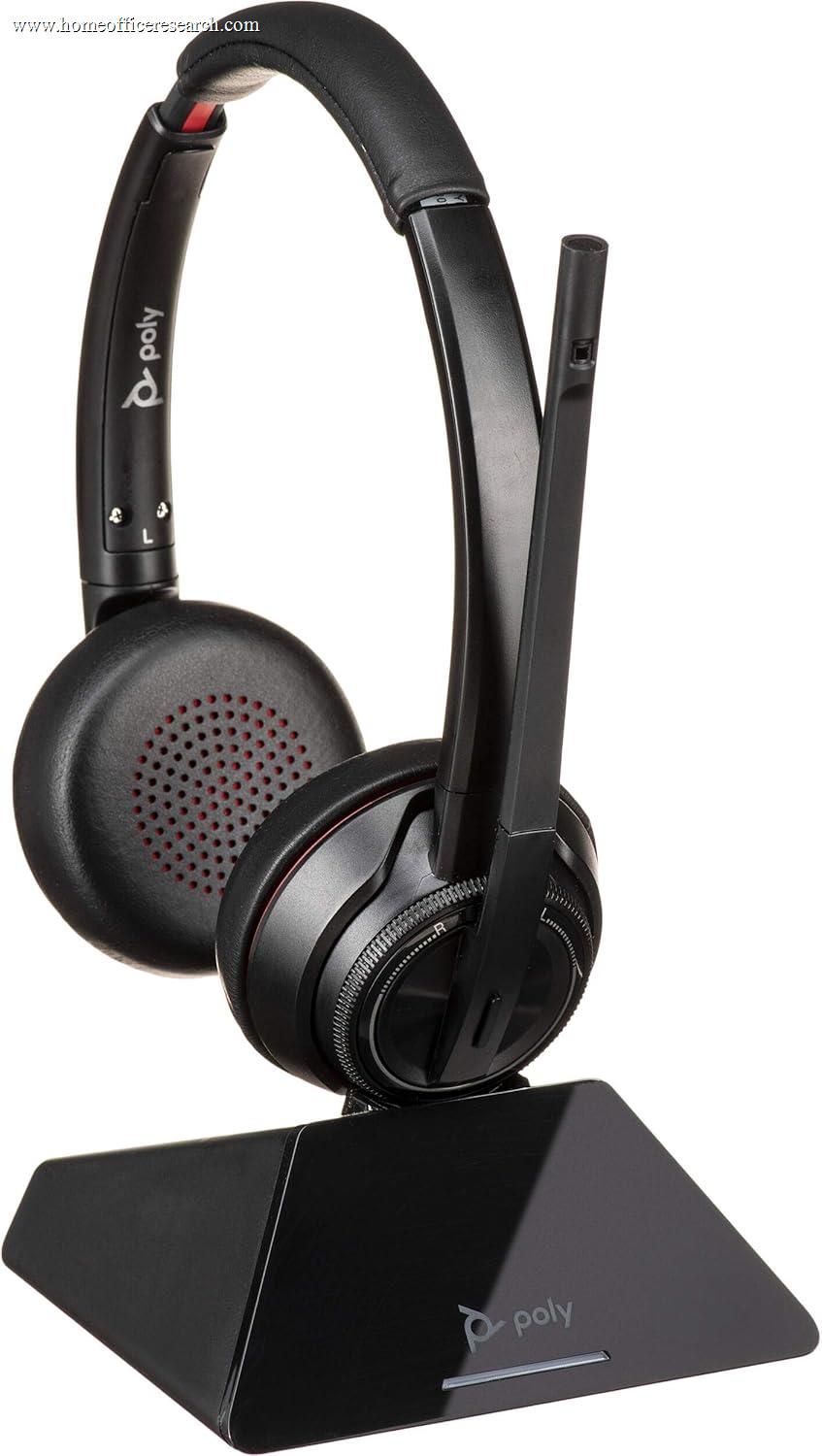
The Poly Savi 8220 UC is the headset to buy when range is the priority. Instead of Bluetooth, it uses a DECT base station that lets you roam up to roughly 590 feet line-of-sight — realistically about 180 feet through office walls — while staying on the call, far beyond what any Bluetooth model here can manage. It’s also one of the rare DECT headsets with active noise cancellation, pairs a noise-cancelling boom with close-conversation limiting for a clean far-end voice, and docks on its base between calls. The trade-offs are real: a 13-hour battery that’s modest for this group, a base-station footprint, and a UC configuration that connects to your computer only. But if you wander far from your desk while talking, nothing else here keeps up.
How We Scored It
Category Deep-Dives
Microphone & Voice
8.5 / 10 25% weightingThe Savi 8220 mounts a proper noise-cancelling boom microphone close to your mouth — the gold-standard placement for call clarity — and backs it with Poly’s close-conversation limiting, which tightens the pickup zone so a colleague talking a few feet away or general room noise is held back. The result is a clean, professional far-end voice that holds up well in a busy office.
It’s an excellent microphone that sits just below the lineup’s very best — the boom-down Jabra Evolve2 75 and Poly’s own Acoustic Fence on the Voyager Focus 2. Crucially, because this is a DECT system rather than Bluetooth, the voice quality stays consistent across the headset’s entire long range, not just when you’re near the computer.
Bottom line on microphone: A real noise-cancelling boom plus close-conversation limiting deliver a clean voice that stays consistent across the full DECT range. Among the stronger mics here.
Comfort & Wearability
8.0 / 10 20% weightingThis is the stereo, dual-ear model of the Savi 8200 range, with cushioned on-ear pads on both sides — better for focus and call immersion than a single-ear style, and comfortable for long desk sessions. The headband and ear cushions are built for all-day enterprise use, and an integrated SoundGuard Digital system caps sudden loud sounds above 118 dBA to protect your hearing over a full workday on calls.
It’s genuinely comfortable, if a notch behind the plushest options in this guide — the over-ear Poly Voyager Focus 2 and Logitech Zone Wireless 2 envelop the ear more completely. As an on-ear design it runs cool and light, which suits the all-day, desk-bound use this headset is built for.
Bottom line on comfort: Comfortable dual-ear on-ear design with hearing-protection built in. A step behind the plushest over-ear rivals, but well-suited to all-day desk wear.
Audio Quality
7.5 / 10 15% weightingAs a stereo headset, the Savi 8220 covers both ears and delivers clear, intelligible audio for calls, conference bridges, and the occasional focus playlist. It also includes genuine active noise cancellation for the wearer — a real rarity in DECT headsets, most of which skip ANC entirely — so you can quiet steady background noise on your end while you work.
Where it lands a notch lower is that it’s tuned squarely for voice rather than music, and its audio platform is built for enterprise telephony rather than rich media playback. It’s perfectly good for the job, but the Bluetooth models in this guide — and especially the consumer-grade AirPods Pro 3 — pull ahead for outright sound quality and the polish of their noise cancelling.
Bottom line on audio: Clear stereo call audio plus rare-for-DECT active noise cancellation. Tuned for voice over music, so it trails the Bluetooth and consumer options on outright sound.
Connectivity & Range
7.5 / 10 15% weightingRange is the entire reason this headset exists, and it’s exceptional. The DECT 6.0 base broadcasts on its own dedicated 1.9 GHz band — separate from the crowded 2.4 GHz spectrum that Wi-Fi and Bluetooth fight over — so it’s both far-reaching and highly interference-resistant. You can roam up to about 590 feet line-of-sight, or roughly 180 feet through typical office walls, and stay on your call the whole time. Step away to a printer, the kitchen, or another room without dropping a word. An adaptive power system quietly downshifts when you’re near the base to conserve battery.
The catch, and the reason this score is good rather than great, is flexibility. This UC configuration connects to your computer only through its USB-A base — it doesn’t bridge a desk phone or Bluetooth mobile the way the multi-device Savi “Office” configurations do. So you trade the convenient two-device multipoint that the Bluetooth headsets here offer for unmatched single-source range.
Bottom line on connectivity: Class-leading DECT range — up to ~590 ft, interference-resistant — but the UC config is computer-only, without the multi-device flexibility of the Bluetooth models. Pure range over versatility.
Battery & Reliability
7.0 / 10 15% weightingBattery is the Savi 8220’s most ordinary trait. Talk time is rated at up to 13 hours with a roughly 3-hour full recharge — fine for a single day, but well short of the 24-to-35-hour runtimes the Jabra and Poly Bluetooth models post. The saving grace is the workflow: this is a desk system, and you simply dock the headset on its base whenever you’re not wearing it, so in practice it’s topped up far more often than a portable headset and rarely dies mid-day. Standby runs to about two days.
Reliability itself is solid — Poly is an established enterprise-audio name, DECT is a mature and dependable wireless standard, and the base provides a fixed, predictable connection. But the modest runtime and the fact that you’re tethered to a base rather than carrying a long-life portable keep this category in amber rather than green.
Bottom line on battery & reliability: A modest 13-hour battery offset by constant base-docking, on a mature and dependable DECT platform. The short runtime is the main reason this lands in amber.
Controls, Software & Value
7.0 / 10 10% weightingOn-headset controls handle volume, mute, and call answer/end, and the base gives you a physical docking and charging point with status indication. It’s certified for Microsoft Teams and works with Zoom and other softphones. As an enterprise DECT system, though, it leans on IT-oriented management rather than the friendly consumer companion apps — there’s none of the Logi Tune or Jabra Sound+ EQ-and-tweaking polish that the Bluetooth models offer, and no integrated busylight.
On value, this is a specialist tool. The base-station hardware makes it pricier and bulkier than a simple Bluetooth-plus-dongle headset, and the computer-only UC config narrows who it suits. For the specific buyer who needs to roam far from the desk while talking, that premium is absolutely worth paying; for everyone else, a Bluetooth model delivers more everyday flexibility for less. That specialist positioning is what places this category in amber.
Bottom line on controls, software & value: Solid Teams-certified controls and a handy charging base, but no consumer app polish or busylight, and a specialist price. Worth it only if you genuinely need the range.
About the Manufacturer
Poly is the professional audio and communications brand formed from the 2018 merger of Plantronics — a headset pioneer whose hardware carried the first words spoken from the Moon — and Polycom, a leader in conferencing. In 2022 Poly became part of HP, folding into its broader work-from-anywhere portfolio.
The Savi line is Poly’s DECT range, built for professionals who need maximum wireless range and rock-solid, interference-resistant connections from a desk base — a different mission from the portable Bluetooth Voyager headsets. The 8200 series sits at the top of that line, and the 8220 is its dual-ear, noise-cancelling flagship, one of the very few DECT headsets to include active noise cancellation.
For home office buyers who roam far from their desk while on calls, Poly’s DECT engineering offers range no Bluetooth headset can match — which is exactly why the Savi 8220 UC is our Best for Range pick.