Mi Monitor Light Bar
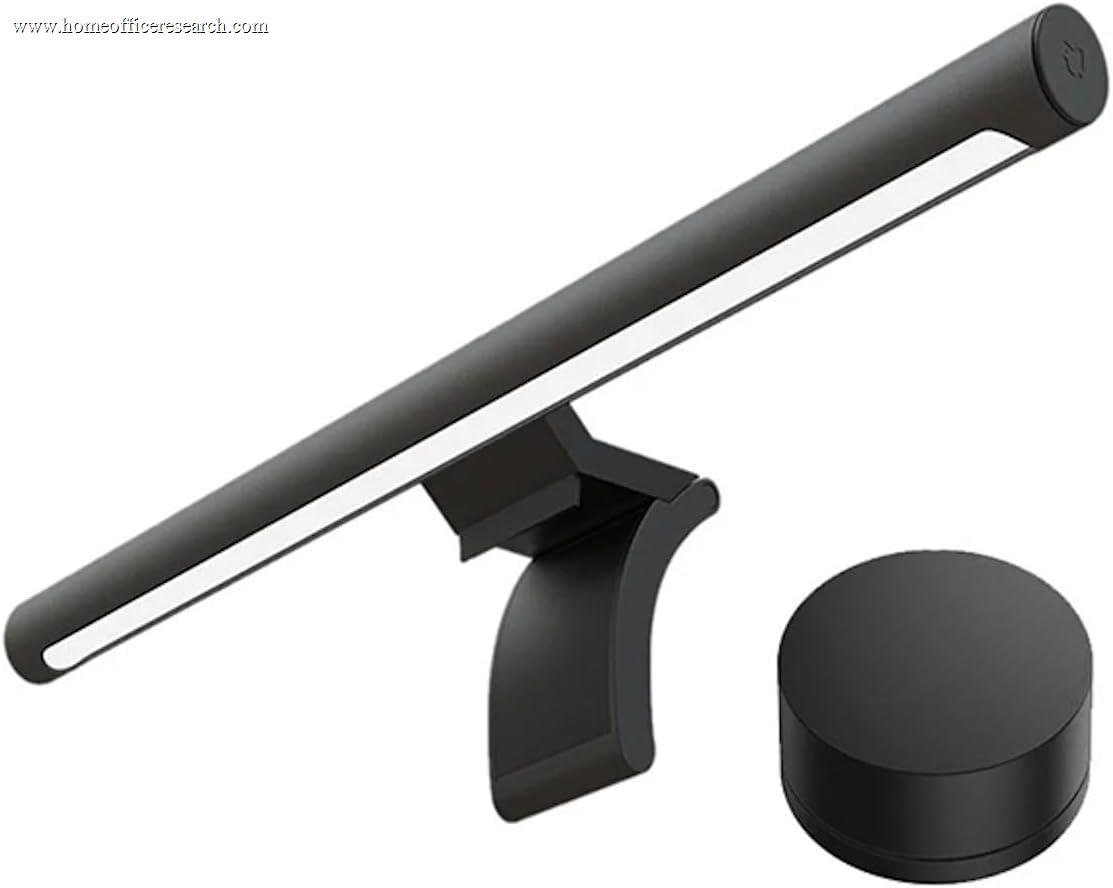
The Xiaomi Mi Monitor Light Bar is the most credible budget alternative to BenQ’s screen bar lineup — and it’s not close. CRI 90 and a full 2700–6500K color temperature range come close to BenQ’s flagship specs. Continuous dimming via an included wireless rotary remote is a more elegant control system than the touch sensors on many competitors at significantly higher price points.
How We Scored It
Category Deep-Dives
Light Quality
8.5 / 10 30% weightingCRI 90 sits just below the BenQ ScreenBar Pro’s 95+ — still impressive at this price tier. (The global version of this bar is rated Ra95; the US model we link, ASIN B08W2C5W59, is Ra90.) The full 2700–6500K range gives equal color temperature flexibility. Maximum lux output, however, is approximately 545 lux at the center of the illumination cone (based on third-party measurements) — roughly half the BenQ’s 1,000+ lux.
For most desk tasks, 545 lux is adequate; the ANSI minimum for office work is 500 lux, which the Xiaomi meets at the center of its coverage area. Users with very large desks or who perform detail work requiring high illuminance may notice the output difference in practice. Asymmetric optics prevent monitor glare, consistent with the screen bar category standard.
Bottom line on light quality: CRI 90 and a full color temperature range punch well above the price point. Maximum lux output is adequate for most tasks but meaningfully below the BenQ for users who need high illuminance across a wide desk area.
Adjustability & Control
8.5 / 10 25% weightingThe included 2.4GHz wireless remote is the Xiaomi’s most distinctive user experience feature. A smooth rotary dial adjusts brightness and color temperature from desk level without reaching to the monitor top — a genuinely elegant interaction compared to the touch-strip controls on the standard BenQ ScreenBar. The magnetic rotation clip allows 25° of vertical tilt adjustment for glare management.
8.5 rather than a higher score reflects that the wireless remote has attracted occasional reports of sync dropouts in environments with 2.4GHz congestion, and that the bar has no ambient light sensor for auto-brightness.
Bottom line on adjustability: The wireless rotary remote is a genuine advantage over touch-strip competitors at higher price points. The absence of an ambient light sensor is a minor gap; 2.4GHz dropout reports are infrequent but worth noting.
Eye Comfort
7.0 / 10 20% weightingThis is where the Xiaomi’s primary gap versus BenQ lives. The manufacturer has published a flicker-free test report — a meaningful step above unsupported claims — but has not obtained IEEE PAR 1789 certification, which requires independent third-party verification. Flicker performance at low brightness settings, where PWM artifacts are most problematic, cannot be confirmed to the same standard as the BenQ lineup.
For users without a history of screen-related headaches or eye fatigue, this is an acceptable tradeoff at the price difference. For users who are specifically sensitive to flicker or who dim lamps frequently during evening use, the BenQ’s certified performance is worth the premium.
Bottom line on eye comfort: Manufacturer-published flicker testing is better than nothing, but the absence of IEEE PAR 1789 certification means flicker performance at low brightness cannot be independently confirmed. The deciding factor for flicker-sensitive buyers.
Build & Design
8.0 / 10 15% weightingThe Xiaomi’s metal body construction is noticeably more premium than the plastic builds common on competing lamps at similar price points. The counterbalanced clip is stable and adjustable. The overall package — metal bar, included wireless remote, clean cable management — presents as a product significantly above its price tier.
8.0 reflects good build quality with the minor note that the clip mechanism, while adequate, is less precisely engineered than BenQ’s equivalent.
Bottom line on build: Metal construction at this price is a genuine overdelivery. The clip mechanism is adequate rather than exceptional — a minor deduction from an otherwise premium-presenting package.
Value
9.5 / 10 10% weightingThe Xiaomi Mi Monitor Light Bar is the outright value champion in this guide. CRI 90 and a full color temperature range at a budget price point are genuinely strong specifications. The wireless remote is included. The metal build is better than comparable products at significantly higher prices. The value score reflects this near-maximum performance-per-dollar rating.
The 9.5 rather than 10.0 is a marginal note: the Quntis L206 offers IEEE-certified flicker-free performance at an even lower price point, a potentially better value for the flicker-sensitive buyer.
Bottom line on value: Near-maximum performance-per-dollar in this category. The Quntis L206 edges it for flicker-sensitive buyers, but the Xiaomi’s combination of CRI 90, full color temp range, and included wireless remote at a budget price is genuinely hard to beat.
About the Manufacturer
mi
Xiaomi was founded in 2010 in Beijing, China, by Lei Jun and six co-founders. It is one of the world’s largest consumer electronics companies by volume, with a product portfolio spanning smartphones, smart home devices, wearables, and PC accessories. Xiaomi has historically pursued a strategy of delivering flagship-competitive specifications at significantly reduced prices — a positioning strategy that the Mi Monitor Light Bar exemplifies within the desk lighting category.
The Mi Monitor Light Bar was released to expand Xiaomi’s peripheral ecosystem for PC users. It was designed with direct reference to the BenQ ScreenBar category, offering CRI 90 specifications and a full color temperature range in a product priced to be accessible as a standard desk accessory rather than a premium purchase. Xiaomi products are available through Amazon, Xiaomi’s own website, and various electronics retailers. The Mi Monitor Light Bar ships internationally and is one of the most widely reviewed non-BenQ screen bars in the category.