L206 Screen Bar
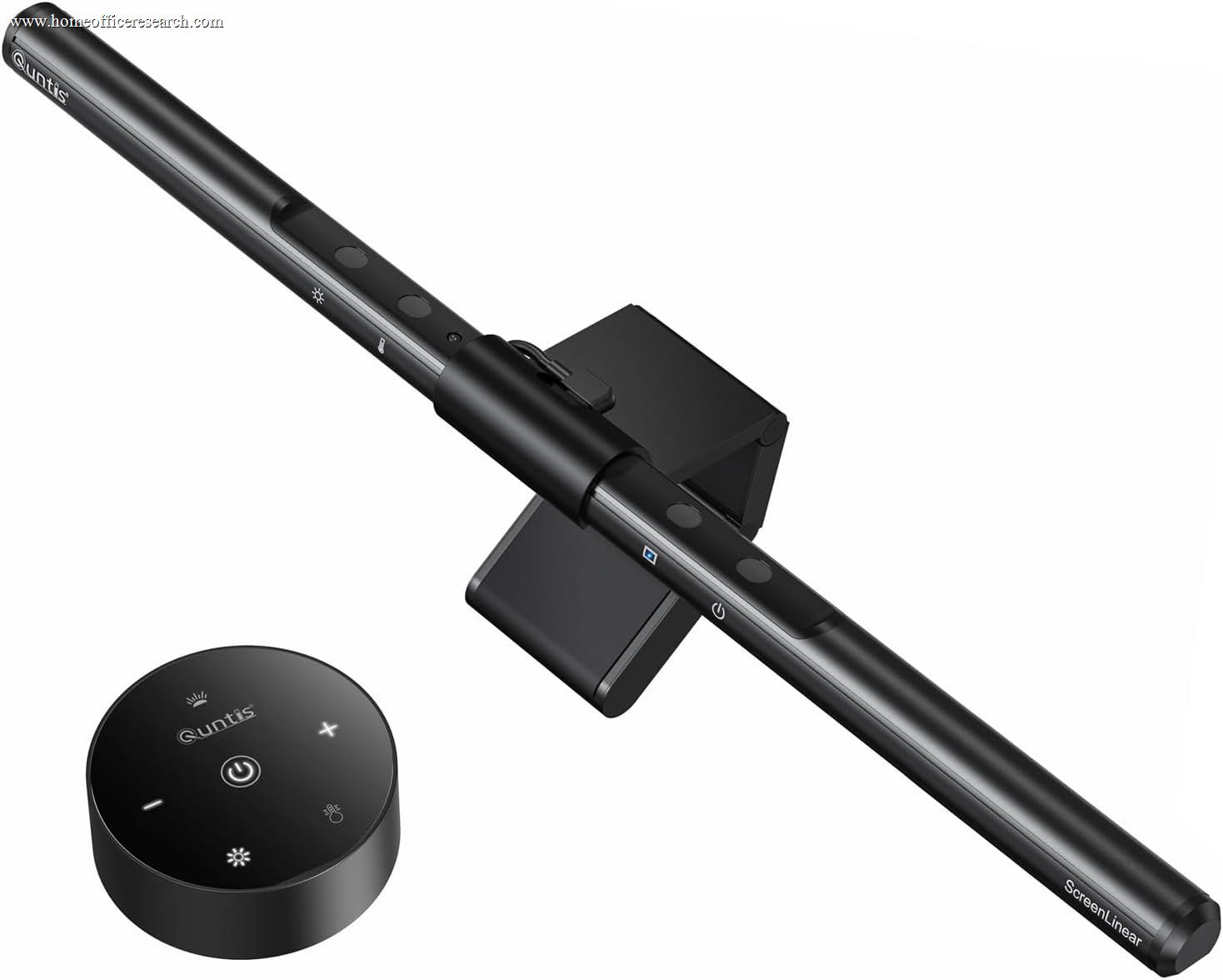
The Quntis L206 earns its position in our top six by doing something few budget screen bars achieve: manufacturer-claimed flicker-free performance. CRI 92 is below the BenQ and Xiaomi’s 95 threshold but above the 90+ floor that warrants recommendation, and 900 lux maximum output is strong for the price tier. It concedes ground on color temperature range (3000K minimum rather than 2700K) and control precision (10 discrete levels rather than continuous). But for the buyer who wants manufacturer-claimed flicker-free performance at the lowest possible price, the L206 is the most defensible choice in the category.
How We Scored It
Category Deep-Dives
Light Quality
8.0 / 10 30% weightingCRI 92 sits in a useful range — noticeably better than the CRI 80 floor common in budget lamps, and competitive without matching the CRI 95 benchmark of the premium options. Maximum lux is rated at 900, which is genuinely competitive and adequate for all standard desk work. The color temperature range of 3000–6500K is the primary specification gap: the 3000K warm end (versus 2700K on BenQ and Xiaomi) is perceptibly cooler for evening use. Users who want a warm incandescent-like feel for evening work will notice this limitation; users who primarily use the lamp for daytime work may not.
Asymmetric optics for glare control are present and effective — this is standard equipment in the screen bar category. The optics direct light downward onto the desk surface without casting direct glare onto the monitor, which is the core functional requirement of a screen bar design. The L206 meets this requirement fully.
Bottom line on light quality: CRI 92 and 900 lux are solid at this price tier. The 3000K floor rather than 2700K is the one genuine compromise versus premium alternatives.
Adjustability & Control
7.5 / 10 25% weightingTen discrete brightness levels are functional but represent the lower end of what we’d recommend for all-day use. The BenQ lineup’s continuous dimming and Xiaomi’s wireless remote both offer finer brightness resolution. Color temperature is adjustable across the 3000–6500K range. Controls are touch-based on the bar itself — no wireless remote is included or available. For users who adjust brightness frequently throughout the day, the discrete-step limitation is noticeable; for users who set a level and leave it, it is not.
The 7.5 reflects adequate but not exceptional control flexibility, appropriate for the price tier. This is the category where the L206 most clearly shows the tradeoffs made to achieve manufacturer-claimed flicker-free performance at a budget price point. Buyers who prioritize control precision should move up to the Xiaomi Mi Monitor Light Bar or BenQ ScreenBar.
Bottom line on adjustability: Functional for most use cases. The 10-level discrete dimming is a real concession versus continuous-dimming competitors. No remote option available.
Eye Comfort
9.0 / 10 20% weightingThe L206’s highest individual category score — and its clearest differentiator in the budget tier. Quntis specifically markets the L206 against the IEEE PAR 1789 flicker standard, which is unusual at this price: most budget screen bars either claim flicker-free operation in passing or say nothing at all. We could not confirm an independent third-party certificate for the L206 specifically, so we treat this as a manufacturer claim rather than verified certification — but a brand that references the IEEE 1789 standard by name is a step above those making only a vague “flicker-free” assertion.
Flicker matters because some people report eye strain or fatigue under heavy flicker, even at frequencies above the threshold of conscious perception — the concern the IEEE PAR 1789 recommended practice is designed to address. A blanket “flicker-free” claim measured only at 100% brightness can obscure flicker that appears at lower brightness levels, a common issue with PWM dimming. Quntis’s reference to the full IEEE 1789 standard implies attention to the whole dimming range, which is the meaningful case for real-world use — though, again, this rests on the manufacturer’s claim absent an independent certificate.
For buyers whose primary concern is documented flicker-free performance at minimum cost, the L206 is among the most rational choices in the guide. The one-point deduction from a perfect 10.0 reflects that even a strong flicker claim doesn’t eliminate all potential eye comfort issues — CRI and color temperature choices affect eye strain as well, and the L206’s 3000K floor is slightly less comfortable for extended evening use than 2700K alternatives.
Bottom line on eye comfort: The L206’s standout category. A flicker-free claim referenced to IEEE PAR 1789 at a budget price is the key specification that justifies its position in our top six.
Build & Design
7.5 / 10 15% weightingPlastic construction, adequate clip mechanism, functional touch controls. Build quality is consistent with the price tier — solid enough for desk use without the premium feel of BenQ’s or Xiaomi’s metal construction. The included USB-A charging port is a practical addition that adds utility without adding cost for users whose monitors don’t have built-in USB hubs. Cable management is clean. No concerns about structural integrity under normal use, but no premium material touches either.
The counterbalanced clip mounting system functions as expected — it balances on top of the monitor without putting mechanical stress on the screen. Screen bar mounting has become well-standardized across the category, and the L206 executes it at an appropriate level for its price tier. The unit is lightweight, which reduces concern about long-term stress on monitor hinges.
Bottom line on build: Functional plastic construction appropriate for the price tier. The USB-A pass-through port is a practical bonus. No structural concerns; no premium material feel either.
Value
9.0 / 10 10% weightingThe L206 is the least expensive screen bar in our guide to market itself against the IEEE 1789 flicker standard. CRI 92, 900 lux, and that flicker-free claim at a budget price represent a value proposition that is difficult to argue with for buyers who prioritize flicker performance above all other specifications. The screen bar category is one where meaningful price stratification exists — budget and premium tiers represent genuinely different specification levels — but the L206 brings the most important premium specification (a documented, IEEE-1789-referenced flicker-free claim) to the budget price tier.
The 9.0 rather than the Xiaomi’s 9.5 reflects the narrower color temperature range and lower CRI of the L206 — the Xiaomi delivers better overall specifications, though it publishes its own flicker test report rather than referencing the IEEE 1789 standard the way Quntis does. Buyers choosing between them are making a specific tradeoff: more comprehensive light quality versus a stronger flicker-free claim. Both are defensible choices depending on individual priorities.
Bottom line on value: The strongest value-for-flicker-claim ratio in our guide. If a documented flicker-free claim at minimum cost is the priority, this is the correct choice.
About the Manufacturer
tis
Quntis is a consumer electronics accessories brand based in Shenzhen, China, specializing in monitor-adjacent products including screen bars, USB hubs, and laptop stands. The brand markets its screen bars against the IEEE PAR 1789 flicker standard across the lineup — a specification focus that distinguishes it from many budget competitors who make only a vague “flicker-free” claim, even though we could not independently confirm a third-party certificate for the L206.
The L206 is Quntis’s primary screen bar offering and has accumulated a substantial number of independent user reviews on Amazon. Unlike many accessories-focused brands that prioritize feature count over named specifications, Quntis consistently cites the IEEE 1789 flicker standard for its products — a notable focus for a brand at this price tier. This suggests an engineering philosophy that emphasizes a measurable flicker spec over marketing-driven feature lists.
Quntis products are available primarily through Amazon. The brand does not operate a direct-to-consumer sales channel or a dealer network, which is typical for Shenzhen-based accessories manufacturers at this price tier. Customer support is Amazon-mediated.