CanoScan LiDE 400
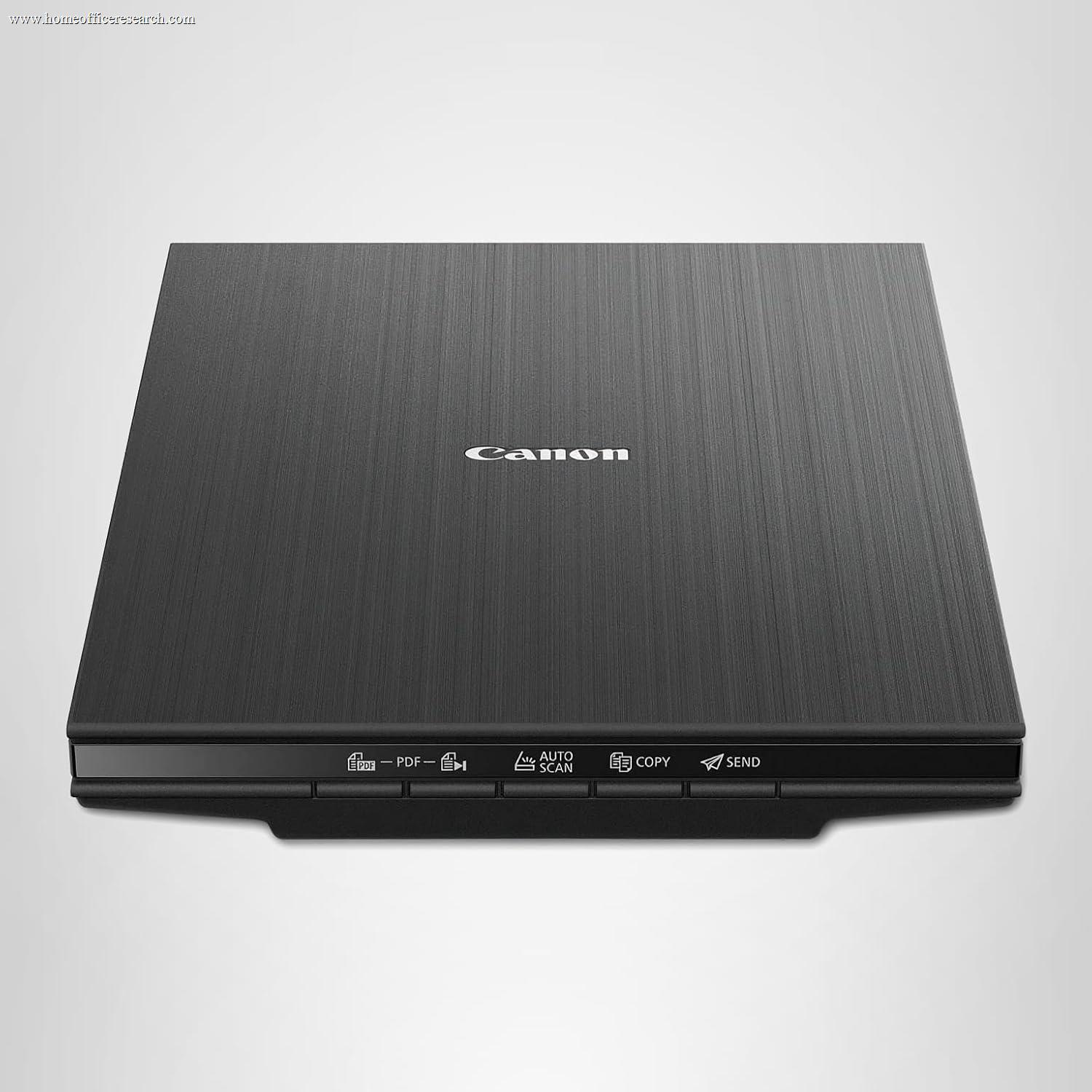
The Canon CanoScan LiDE 400 is the budget flatbed — a slim, single-cable scanner that does the flatbed essentials for very little money. It captures at a high 4800 dpi over USB-C, which carries both power and data, and adds five one-touch EZ buttons for quick scan-and-send. Like any flatbed, it’s the right tool for books, photos, and fragile originals rather than batches of loose paper, and its software is more basic than Epson’s. But if you mainly need an inexpensive way to scan the occasional book page, photo, or delicate document alongside a faster document scanner, it’s hard to argue with the value.
How We Scored It
Category Deep-Dives
Scan Quality & Accuracy
8.5 / 10 25% weightingThe LiDE 400 captures at 4800 × 4800 dpi optical with 48-bit color, matching the Epson V39 II for image fidelity and far exceeding anything documents require. Pressed flat on the glass, originals scan cleanly with no feed skew, making it genuinely good for photos and detailed material as well as paperwork.
As with any flatbed, treat the headline 19,200 dpi interpolated figure as marketing — those are software-invented pixels that add nothing for real documents or photos. The number that matters is the 4800 dpi optical, and it’s excellent.
Bottom line on scan quality: Excellent 4800-dpi optical capture and 48-bit color — image fidelity on par with the best flatbed here, well beyond document needs.
Speed & Throughput
5.5 / 10 20% weightingThe LiDE 400 scans a Letter page in roughly 8 seconds at 300 dpi — marginally faster per page than the Epson V39 II — but you place and lift each original by hand, with no automatic feeder.
That makes it unsuited to batches of loose paper, and on our throughput-weighted framework a no-feeder flatbed lands near the bottom on speed, which is the main reason it sits in the amber band overall. Like every flatbed, its purpose is the originals a feeder can’t take, not volume scanning.
Bottom line on speed: About eight seconds per page, one at a time — slightly quicker than the Epson flatbed, but still no match for an ADF on volume.
Software & OCR
6.5 / 10 20% weightingThe LiDE 400 uses Canon’s IJ Scan Utility plus five physical EZ buttons — Auto Scan, Copy, two PDF buttons (start and finish a multi-page scan), and Send — for quick, one-press scanning to PDF or email.
It’s functional and convenient for simple tasks, but the software is more basic than Epson’s ScanSmart on the flatbed side — OCR and document organization aren’t as developed. For straightforward scan-to-PDF and copying it’s fine; if searchable-document workflows matter to you, the Epson flatbed’s software is the stronger package.
Bottom line on software: Functional Canon utilities and five EZ buttons cover the basics, but OCR and organization lag the Epson flatbed’s ScanSmart.
Paper Handling & Versatility
6.0 / 10 15% weightingThe LiDE 400 does what flatbeds do: it scans books, photos, and fragile or stapled originals safely on its glass, items a sheet feeder would risk damaging. A vertical stand option helps it save desk space.
Its lid is a standard flatbed lid rather than the high-rise, removable type on the Epson, so very thick books are a little less accommodating. And, of course, there’s no feeder — it’s strictly one original at a time. It’s versatile on media type, not on volume.
Bottom line on paper handling: Handles books, photos, and fragile originals on the glass, with a space-saving vertical stand — but one item at a time, no batch.
Connectivity
6.0 / 10 10% weightingConnectivity is minimal and tidy: a single USB-C cable carries both power and data, so there’s no separate power supply — a clean, modern touch for a budget scanner.
But there’s no Wi-Fi and no independent operation, so the LiDE 400 must be connected to a computer to scan, and you drive it from there (or via the EZ buttons). For a flatbed that lives by a desktop machine that’s reasonable, but it’s a tethered peripheral, which is why connectivity scores in the amber band.
Bottom line on connectivity: A single USB-C cable for power and data keeps it elegantly simple, but there’s no Wi-Fi — it stays tethered.
Reliability & Value
8.5 / 10 10% weightingThe LiDE 400 is a slim, simple, dependable unit — bus-powered with few moving parts — carrying a one-year limited warranty. Its single-cable design and light weight make it easy to live with.
Value is its strongest suit: it’s typically the cheapest flatbed in this guide, delivering high-resolution capture for books, photos, and fragile documents at a budget price. You trade away Wi-Fi and some software polish, but as an inexpensive companion to a faster document scanner — handling the jobs an ADF can’t — it’s an easy, sensible buy.
Bottom line on reliability & value: The most affordable flatbed here, slim and simple with a one-year warranty — excellent value as a second scanner for books and photos.
About the Manufacturer
Canon, founded in Japan in 1937, is a global leader in imaging and optics. Its CanoScan line covers consumer flatbed scanners for documents and photos, alongside the imageFORMULA sheet-fed document scanners higher up this guide.
The CanoScan LiDE 400 is the slim, USB-powered flatbed of the range — built around high-resolution capture, single-cable simplicity, and physical EZ buttons for quick scanning, at an affordable price.
For home office buyers, the LiDE 400 is Canon’s budget flatbed answer: an inexpensive, capable way to scan books, photos, and fragile originals as a complement to a faster document scanner.