XS2000
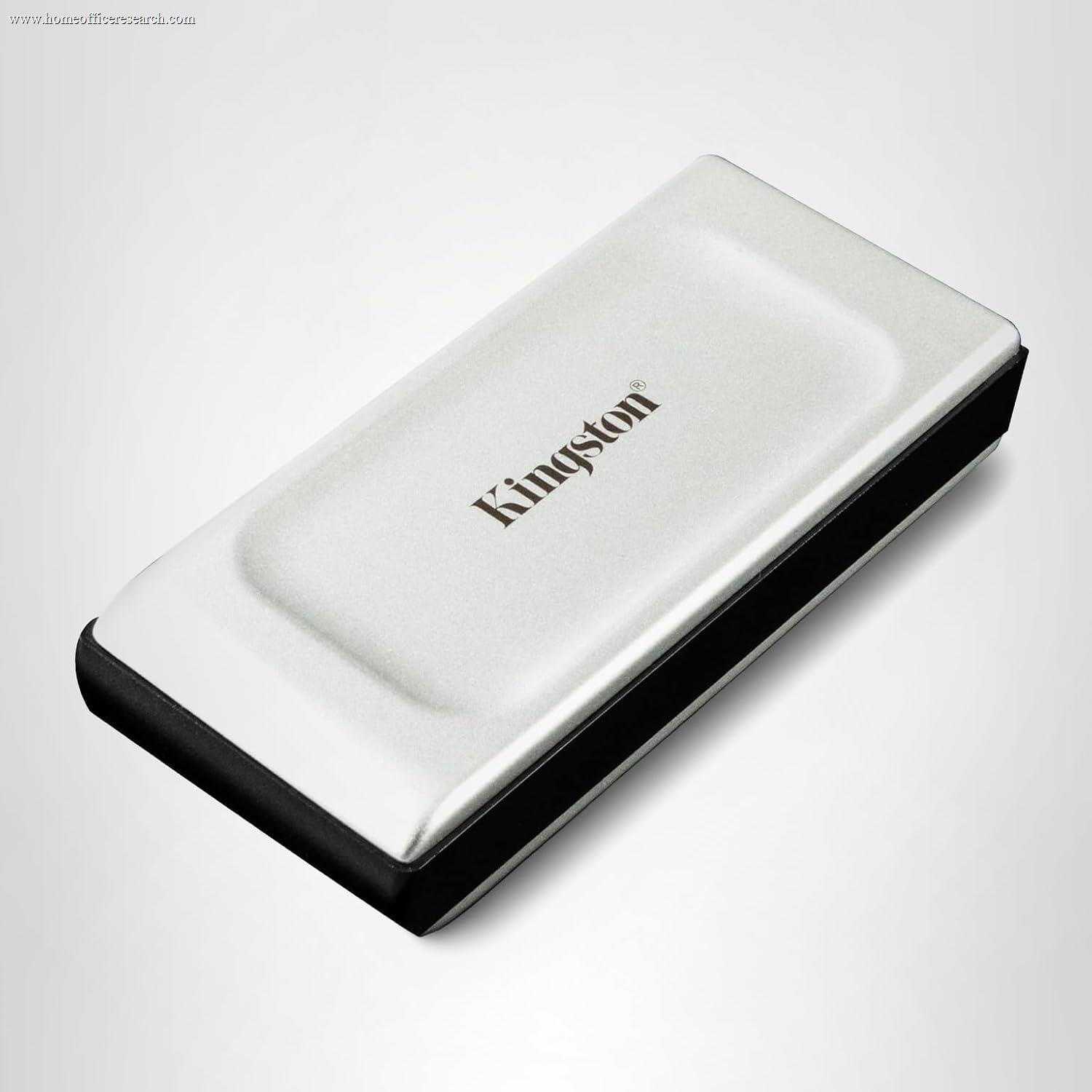
The Kingston XS2000 doubles the interface of its little brother — USB 3.2 Gen 2×2 (20 Gbps) instead of 10 — and hits a rated 2,000 MB/s read and write in the same pocket-sized, sub-30-gram shell. On short transfers it’s genuinely fast. But it’s a DRAM-less drive, so sustained writes to a large folder fall off sharply once the cache is exhausted, and that headline speed only appears on a relatively rare 20 Gbps Gen 2×2 port. It adds an IP55 rating — but only with the bundled rubber sleeve attached — and, like the XS1000, ships with no hardware encryption and no software. A fast, tiny drive held back by inconsistent sustained writes and a bare feature set.
How We Scored It
Category Deep-Dives
Real-World Performance
7.0 / 10 25% weightingThe XS2000 runs over USB 3.2 Gen 2×2 (20 Gbps) and is rated for up to 2,000 MB/s read and write — and on short, cache-friendly transfers it delivers, making it one of the fastest native-USB portable drives in its class. For everyday file shuttling and quick backups it feels every bit the 20 Gbps drive.
The catch is sustained writing. Like the XS1000, it’s a DRAM-less design, so once the SLC write cache fills, large continuous transfers slow dramatically — independent testing measured the write rate collapsing from roughly 1,890 MB/s to a few hundred MB/s while filling the drive. For a single big copy that’s a real difference versus DRAM-equipped rivals like the Crucial X10 Pro. That inconsistency, plus the fact that the full 2,000 MB/s only appears on a true Gen 2×2 host, holds Performance to 7.0 despite the headline speed.
Bottom line on performance: Blistering on short bursts and a genuine 20 Gbps drive, but DRAM-less sustained writes fall off hard on big folders — and the top speed needs a 2×2 port to show up at all.
Reliability & Endurance
7.0 / 10 25% weightingKingston is a long-established, high-volume memory maker, and the XS2000 uses 3D TLC NAND (better for endurance than the QLC found in some budget drives) paired with a mature Silicon Motion SM2320 controller, backed by a five-year limited warranty. There’s no specific reliability flag here — it’s a competent drive from a reputable brand.
It lands at 7.0 rather than higher for the same reasons as its sibling: it’s DRAM-less, Kingston doesn’t publish detailed endurance (TBW) figures, and pushing 20 Gbps in a tiny aluminum shell means it can run warm under sustained load, which can prompt thermal throttling. None of that is disqualifying, but it lacks the published-endurance pedigree of the Crucial (Micron) and Samsung step-up drives. As always — and doubly for any single portable drive — keep a second backup; never let this be the only copy of anything important.
Bottom line on reliability: Solid TLC and a five-year warranty with no red flags — just without the published-endurance headroom of the pricier picks, and it can warm up at full speed.
Durability & Build
6.5 / 10 15% weightingThe XS2000 is remarkably small and light — about 28.9 g and roughly the size of a USB thumb drive — with a metal core that helps it shed heat. It’s wonderfully portable, if easy to misplace.
Its headline protection is an IP55 rating against dust and water jets — but only with the bundled rubber sleeve fitted. That’s an important asterisk: slip the sleeve off (as many will, since it adds bulk) and the bare drive carries no ingress protection. There’s also no published drop rating. That conditional ruggedness is a step up from the XS1000’s none-at-all, but it falls short of the always-on IP65 of the Samsung T7 Shield or the fixed IP55 of the Crucial X9 Pro — hence 6.5.
Bottom line on durability: Tiny and well-made, with IP55 protection that depends entirely on keeping the rubber sleeve attached. Rugged with the sleeve, ordinary without it.
Connectivity & Compatibility
7.0 / 10 15% weightingThe drive uses a USB-C (USB 3.2 Gen 2×2) port and, to Kingston’s credit, ships with a USB-C–to–USB-C cable in the box (a welcome upgrade over the XS1000’s C-to-A cable). It’s backward compatible with slower USB ports and works across Windows, macOS, Android, and consoles.
The real compatibility caveat is the interface itself. USB 3.2 Gen 2×2 (20 Gbps) is uncommon — it’s found mostly on some recent AMD and select Intel desktops, and is notably absent from Thunderbolt/USB4 Macs and most laptops, which cap at 10 Gbps. On those far more common ports the XS2000 runs at roughly half its rated speed (~1,050 MB/s), no faster than an everyday-tier drive. You only get what you paid for if your machine has a genuine 2×2 port, and that host dependency is why this sits at 7.0.
Bottom line on connectivity: A proper C-to-C cable in the box, but 20 Gbps Gen 2×2 is rare — on Macs and most laptops you’ll see roughly half the rated speed. Check your port before paying for 2×2.
Value
7.5 / 10 15% weightingFor a 20 Gbps drive, the XS2000 is priced sensibly, and it sweetens the deal with a C-to-C cable, a protective sleeve, capacities up to 4 TB, and a five-year warranty. If you have a true Gen 2×2 port and want maximum burst speed in the smallest possible package, the dollars-per-terabyte is genuinely competitive — which earns it a solid green value score within the high-speed tier.
It stops short of higher because of what your money buys elsewhere. The Crucial X10 Pro costs similar, runs the same 20 Gbps interface, and holds up far better on sustained writes thanks to its DRAM — a meaningfully more consistent drive for big transfers. And the XS2000’s value proposition partly evaporates if your computer lacks a 2×2 port, since you’d be paying for speed you can’t reach. (We don’t list prices because they change often — check the current Amazon price before buying.)
Bottom line on value: Strong value for a pocketable 20 Gbps drive with a full accessory kit — just bettered by the Crucial X10 Pro for anyone who writes large files or wants more consistent speed.
Software & Security
4.5 / 10 5% weightingThis is the XS2000’s clear weak point. Although its SM2320 controller is technically capable of AES-256, Kingston does not enable hardware encryption on this drive, and it ships with no bundled software at all — no password-lock utility, no management or backup app, no health dashboard. If you carry sensitive work files and want the drive itself to be lockable out of the box, this isn’t it.
The mitigating factor — and the reason this category is weighted only 5% — is that you can still encrypt the XS2000 perfectly well with your operating system’s built-in tools: BitLocker To Go on Windows or FileVault on macOS. That’s free and secure; it’s just a manual, OS-dependent step rather than something the drive provides. For a buyer who’ll rely on OS encryption and their own backup routine anyway, the practical impact is smaller than the 4.5 suggests — but as a self-contained secure drive, it simply isn’t one.
Bottom line on software & security: No hardware encryption and no bundled software — a genuine gap. Encrypt it with BitLocker or FileVault if you need protection; choose the WD My Passport or a Samsung drive if you want a built-in password lock.
About the Manufacturer
Kingston Technology is one of the world’s largest independent memory and storage manufacturers, with a decades-long reputation built on dependable, value-oriented DRAM, flash drives, memory cards, and SSDs. It’s a default brand for cost-conscious buyers who still want a recognized name and a real warranty.
The XS2000 is the high-speed flagship of Kingston’s pocket external SSD line, sitting above the 10 Gbps XS1000. It’s designed around a single idea — the fastest native-USB speed (20 Gbps) Kingston can fit in the smallest possible body — and it backs that with capacities up to 4 TB and a bundled protective sleeve. The trade-off for the speed and low price is the stripped-down feature set: no encryption, no software, and ruggedness that depends on the sleeve.
For home-office buyers, the XS2000 is the brand’s pick when you have a 20 Gbps port and want maximum burst speed in your pocket — a fast specialist rather than a do-everything daily driver.