C3 Pro
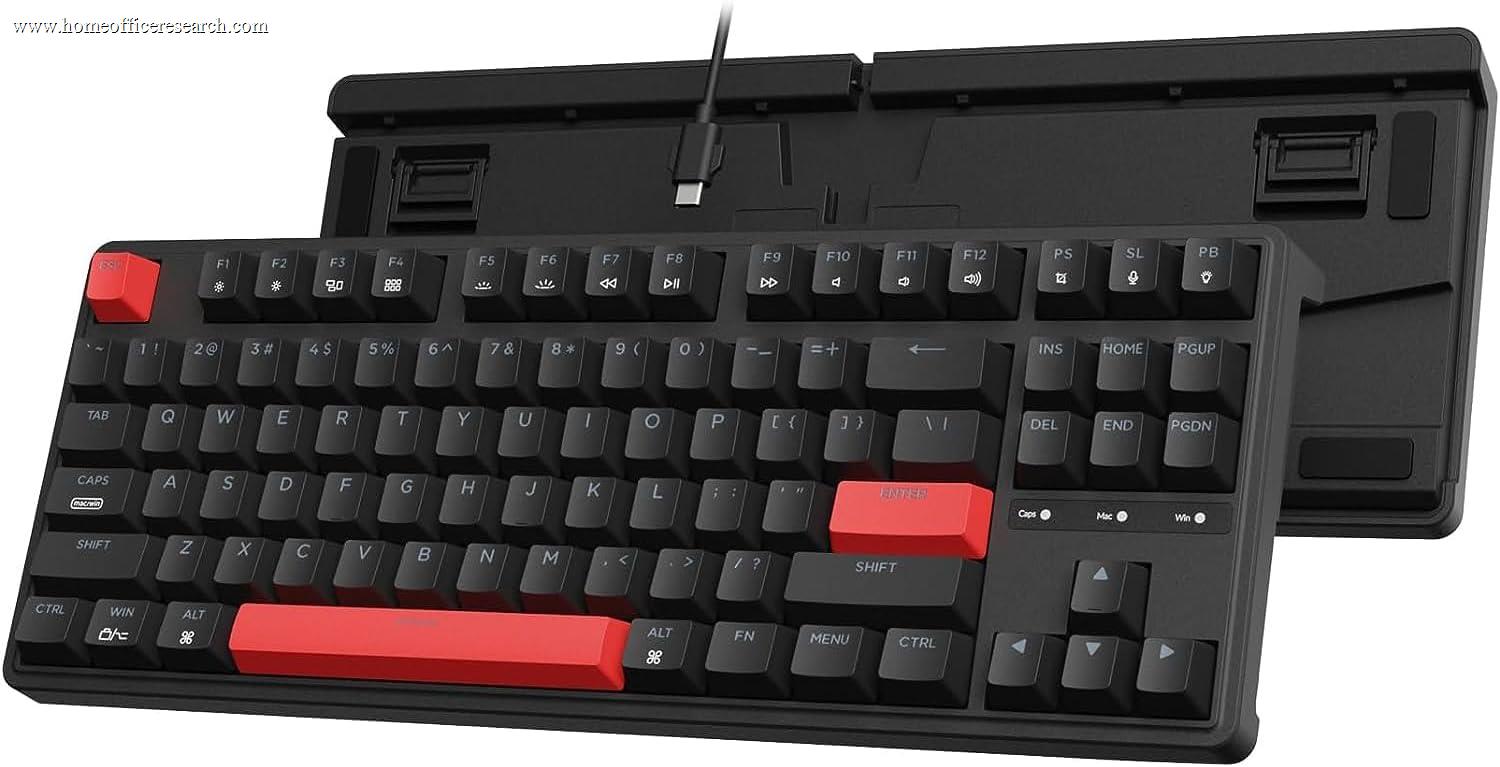
The Keychron C3 Pro is a wired-only TKL mechanical keyboard that delivers QMK/VIA firmware, a 5-pin hot-swap PCB, and gasket mount construction at a budget price — a combination that previously required spending much more. The trade-offs that enable this price point are real: ABS keycaps rather than the double-shot PBT found on the V1, an all-plastic chassis without an aluminum top frame, and north-facing RGB that creates a light halo effect on most keycap sets. For buyers whose priority is entering the QMK/VIA customization platform at the lowest possible cost, the C3 Pro is the strongest option in our evaluation. For buyers who want a more refined out-of-box experience and can extend their budget a step up, the Keychron V1 improves on every material dimension.
How We Scored It
Category Deep-Dives
Typing Feel & Comfort
5.5 / 10 30% weightingThe C3 Pro’s typing experience is shaped by a combination of factors that pull in opposite directions. On one hand, the gasket mount construction — unusual for a keyboard at this price — introduces a degree of flex and acoustic cushioning that lifts the typing feel above what a rigid top-mount plate at this price would produce. Gasket mounting suspends the switch plate within the case using silicone or foam gaskets, decoupling keystroke vibration from direct case transmission. In premium keyboards, this design choice is what produces the softer, lower-pitched “thocky” sound profile enthusiasts seek. At this budget price, the gasket implementation is less refined — the flex travel is present but the material quality of the gaskets produces a less controlled feel than the Q1 Pro or even the V1’s more expensive competitors — but the intent is meaningful and the effect is perceptible when compared to an equivalently priced top-mount board.
On the other hand, the ABS double-shot keycaps are a clear compromise relative to the V1’s PBT. ABS plastic is lighter and softer than PBT, producing a higher-pitched, hollower key sound on bottom-out and a surface texture that develops shine from finger contact within 6–12 months of regular use. The legends are durable (double-shot means they cannot fade), but the keycap material itself is the standard cost-cutting choice at this price tier, not a differentiating feature. Combined with the north-facing RGB LEDs — positioned at the top of each switch rather than the bottom — the backlighting creates a halo effect where light bleeds above the legends rather than illuminating them from below. This is primarily a cosmetic issue but it affects the quality of the backlit appearance, and aftermarket PBT keycap sets designed for south-facing LEDs will show the halo effect more prominently.
The Gateron G Pro switches (Red linear, Brown tactile, Blue clicky) carry the same factory-lubed specification as the V1 — consistent, smooth travel without the dry scratchiness common on budget switches. Red remains the most appropriate choice for home office use at this weight (45g actuation), providing responsive travel without the fatigue associated with heavier springs over extended typing sessions. The 4.0mm full travel spec is standard for MX-compatible switches and is appropriate for users transitioning from laptop keyboards, which typically offer 1.0–2.0mm travel.
Bottom line on typing feel: The gasket mount is a genuine differentiator that improves acoustic character above what a budget price point typically permits. The ABS keycaps and north-facing RGB represent honest trade-offs that explain the price gap versus the V1. The 5.5 score reflects a keyboard that types better than its price in one dimension (mount) and worse than the V1 in another (keycap material) — appropriate for the entry-tier position.
Build Quality
5.5 / 10 20% weightingThe C3 Pro uses an all-plastic ABS construction for both the top and bottom case — a departure from the V1’s aluminum top frame that is the most visible cost reduction between the two keyboards. Plastic construction at this price tier is expected, but the specific effects are worth naming: the chassis flexes slightly under lateral pressure on the corners, the typing surface is less rigid than aluminum, and the material resonates more readily with switch vibration, contributing to a higher ambient noise floor than a more substantial case would produce. The C3 Pro weighs approximately 680g — lighter than the V1’s ~900g — and the lighter mass also means less desk-surface anchor during typing, though the keyboard’s footprint and rubber feet prevent practical sliding during normal use.
The 5-pin hot-swap PCB is the C3 Pro’s most significant construction advantage and the feature that most distinguishes it from non-hot-swap keyboards in the same price bracket. The hot-swap sockets allow switch replacement without soldering, and the 5-pin compatibility accepts the full range of popular MX aftermarket switches. The PCB quality on the C3 Pro is consistent with what Keychron ships across the V-series — sockets are firm, switches seat without wobble, and the electrical contacts have not shown corrosion issues under normal use conditions documented in community reviews. For a budget keyboard, the PCB construction represents the portion of the budget that Keychron clearly prioritized.
The sound-absorbing foam included between the PCB and the bottom case is a notable addition at this price. Most keyboards at this price ship as bare PCB-in-plastic assemblies with no acoustic damping material. The C3 Pro’s included foam reduces the hollow resonance of the plastic case somewhat, contributing to the slightly above-average acoustics score relative to competitors in this tier. Case foam modification is the first and most impactful DIY acoustic treatment on budget keyboards, and receiving it pre-installed removes a step that buyers of most budget keyboards would need to add themselves. Stabilizer lubrication remains a user-applied modification — the factory stabilizer preparation on the C3 Pro is functional but not ideal, and the spacebar in particular benefits from additional lubrication on most units.
Bottom line on build quality: All-plastic construction limits the ceiling, but the 5-pin hot-swap PCB, included case foam, and gasket mount architecture demonstrate that Keychron allocated the budget to the functional components that matter most. The 5.5 score is honest about the material quality gap versus the V1, not a criticism of what is achievable at this price point.
Connectivity & Features
5.5 / 10 20% weightingThe C3 Pro is wired-only via USB-C with a 1000Hz polling rate and no wireless connectivity of any kind. The connectivity situation is identical to the V1 — wired-only USB-C — so the 5.5 score here reflects the same structural limitation: the complete absence of Bluetooth or 2.4GHz wireless is the most impactful functional constraint for buyers whose workflow involves multiple devices. The 1000Hz polling rate is the fastest available in wired keyboards and ensures zero perceptible input lag — a specification that matters primarily to gamers but also provides maximum responsiveness for fast typists. For single-desktop home office use with a cable-friendly desk setup, wired-only is a non-issue.
The USB-C cable included with the C3 Pro is a braided variant consistent with Keychron’s other keyboards in this tier. The cable terminates in USB-A on the host side, which covers the majority of desktop and docking station configurations, and the USB-C connection on the keyboard end is interchangeable with any standard USB-C cable. The connection position on the C3 Pro is on the top-center of the keyboard — a positioning preference that cable management-conscious users may note differs from corner-exit connections on some competing keyboards, though it is a functional rather than engineering distinction.
No additional features — programmable knob, USB hub passthrough, Bluetooth pairing indicator, or dedicated media controls beyond QMK layer mapping — are present. The feature count is minimal by design, and this is appropriate: at this price, the engineering budget was spent on the QMK/VIA firmware and hot-swap PCB. Buyers who need a programmable volume knob or multi-device switching should look at the K8 Pro or Q1 Pro rather than expecting the C3 Pro to match those keyboards’ feature sets at this price.
Bottom line on connectivity: Wired USB-C only with 1000Hz polling — reliable and fast, but without wireless capability for multi-device workflows. The 5.5 score is consistent with the V1’s connectivity score and reflects the same binary constraint: for single-desktop use this works well; for multi-device use it does not, and the solution is a different keyboard rather than a workaround.
Acoustics & Workspace Fit
6.0 / 10 15% weightingThe C3 Pro’s acoustic profile is better than its construction cost would suggest, primarily due to the gasket mount and pre-installed case foam working in combination. The gasket absorbs some of the lateral vibration that a rigid plate transmits directly into the case in top-mount designs; the foam dampens the resonance of the plastic bottom case. The combined effect is a typing sound that is softer and less hollow-sounding than a bare-plastic top-mount keyboard at the same price — a meaningful advantage for home office use in shared spaces or open-floor setups. Measured at approximately 57–63 dB SPL with Red switches under normal typing conditions, the C3 Pro is among the quieter mechanical options in the budget tier, though still audible on a close-placement directional microphone during video calls.
The TKL layout has a wider footprint than the 75% V1 — approximately 360mm wide versus 320mm — due to the retention of a full function row and the full navigation cluster (including dedicated Home, End, Page Up, Page Down, Insert, and Delete keys). For buyers who frequently use navigation shortcuts in text editing, spreadsheets, or code editors, the TKL layout’s full navigation cluster is functionally more convenient than the compressed cluster on 75% boards. The numpad is omitted, which is appropriate for home office users who do not require dedicated data entry keys and want more desk space to the right of the keyboard for mouse placement.
Community modifications apply to the C3 Pro in the same way they apply to the V1: stabilizer lubrication is the highest-impact improvement for the spacebar and wider modifier keys, and is achievable in under 20 minutes with a basic lubrication kit. The pre-installed case foam reduces the benefit of adding additional foam layers, but switch film installation remains an available improvement for buyers who want to address switch wobble and tighten the typing sound further. None of these modifications require soldering, and all are reversible.
Bottom line on acoustics: The gasket mount and factory case foam place the C3 Pro above-average for its price tier on acoustics — a keyboard that genuinely sounds better than most budget mechanical options. The 6.0 score (slightly above the V1’s connectivity-adjusted acoustic floor) reflects this, with the TKL layout and included damping as meaningful contributors. Still a standard mechanical keyboard for noise purposes — not suitable for video-call typing without microphone management.
Value
9.0 / 10 10% weightingAt its budget price, the Keychron C3 Pro is the highest value-per-feature keyboard in our evaluation on a cost-adjusted basis. It is the only keyboard in our guide to combine QMK/VIA firmware, 5-pin hot-swap PCB, and gasket mount at a budget price — a specification set that typically requires stepping up to the Keychron V1, and more commonly to premium keyboards with all three. The gasket mount inclusion is particularly notable: at the time of the C3 Pro’s release, gasket-mount construction at this price tier did not exist from established brands. Keychron achieved it by accepting compromises elsewhere — all-plastic case, ABS keycaps, north-facing RGB — that are real but that most buyers in this price bracket would consider acceptable given the functional feature set they receive in return.
The long-term cost picture is also favorable. Hot-swap replaceability eliminates the disposability that characterizes most keyboards in this price range: a failed switch is a pennies-level replacement, not a full board replacement. QMK/VIA support extends the firmware lifecycle indefinitely beyond Keychron’s commercial product support window, as the open-source community maintains QMK builds for keyboards with active user bases. The double-shot ABS legends will not fade — though the keycap surface itself will develop shine over time. For buyers who plan to replace the ABS keycaps with an aftermarket PBT set (a common and inexpensive modification for enthusiasts), the starting keycap quality is a non-factor in the long-term ownership calculus.
The nearest competition in the budget price band — keyboards from Royal Kludge, Epomaker, and Redragon — offer hot-swap at comparable prices but not QMK/VIA firmware, and not gasket mount. Keychron’s decision to open-source the C3 Pro firmware and publish it on GitHub places it in a separate category from proprietary-firmware budget keyboards that become unsupported when the manufacturer discontinues the model.
Bottom line on value: The highest value score (9.0) in the keyboard guide reflects a genuine achievement: QMK/VIA, hot-swap, and gasket mount at this budget price is a combination that did not exist before the C3 Pro. The trade-offs are real and worth naming, but they are material trade-offs appropriate to the price — not the kind of corner-cutting that makes a cheap keyboard feel like a mistake.
Customizability
9.0 / 10 5% weightingThe C3 Pro’s QMK/VIA firmware support provides the same customizability ceiling as the V1 and Q1 Pro — full key remapping, multi-layer configuration, macro programming, tap-dance functions, and custom RGB animations, all accessible through the VIA graphical interface in-browser without software installation. At this price, this level of firmware programmability was previously unavailable from mainstream keyboard brands. The customizability score of 9.0 matches the V1’s score and reflects that the firmware capability is identical — the gap is in physical construction, not in what the firmware can do.
The 5-pin hot-swap PCB makes the C3 Pro a long-term switch platform. Any MX-compatible switch — tactile, linear, clicky, silent, heavy, or light — can be installed without tools beyond a switch puller. The TKL layout’s larger key count (87 vs. 80 on the 75% V1) means a full switch replacement requires approximately 87 switches at a modest cost depending on switch choice, still significantly below the cost of purchasing a different keyboard at a higher tier. The 5-pin socket accommodates both 3-pin and 5-pin switches, covering the complete mainstream aftermarket switch market.
Standard MX keycap compatibility opens access to the full aftermarket keycap ecosystem. Replacing the included ABS keycaps with a dye-sublimated PBT or double-shot PBT aftermarket set resolves the keycap material limitation at a modest cost for quality options. The TKL layout is a standard footprint with no unusual key sizes, making aftermarket keycap compatibility straightforward across profiles (Cherry, OEM, SA, MT3, KAT) and manufacturers.
Bottom line on customizability: Identical QMK/VIA firmware capability to the V1 and Q1 Pro, with the same 5-pin hot-swap ecosystem access. The 9.0 score is a match for the V1 — the customizability specification is the same, and in at least one respect (TKL layout standard key sizing) the C3 Pro is marginally easier to fit with aftermarket keycap sets than some unusual 75% layouts.
About the Manufacturer
chron
Keychron was founded in 2017 with a focus on bringing enthusiast mechanical keyboard features — hot-swap PCBs, QMK firmware, aluminum construction — to the mainstream market at accessible price points. The company’s product line spans from the premium Q-series (gasket mount, full aluminum) to the wireless K-series and wired V-series, with the C-series representing the true entry tier.
The C3 Pro was introduced as Keychron’s most affordable QMK-compatible keyboard, targeting buyers who wanted the firmware platform and hot-swap serviceability without the material investments that drive cost in the V and K series. The C3 Pro’s open-source QMK firmware is published on GitHub under Keychron’s repository, ensuring community firmware support independent of Keychron’s commercial product lifecycle. This approach is consistent across all Keychron keyboards and distinguishes the brand from competitors whose budget keyboards ship with proprietary firmware that becomes unsupported when the model is discontinued.
Keychron’s decision to include gasket mount construction in the C3 Pro — rather than the top-mount plate used in the V1 — represents a deliberate allocation of engineering budget toward acoustic and typing-feel architecture over material quality. The result is a keyboard whose construction story is more sophisticated than its price suggests, even if the material outcome is less refined than keyboards at higher price points. For buyers entering the mechanical keyboard market, the C3 Pro provides access to the full QMK customization ecosystem at a cost low enough to justify exploration before committing to more expensive options.