X6
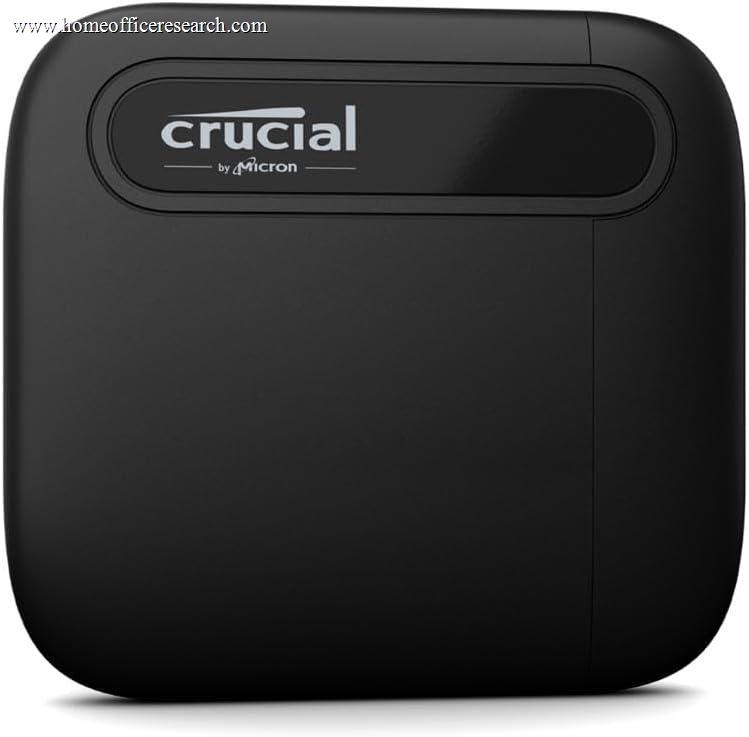
The Crucial X6 has one job: cheap capacity. It’s the most affordable way into 4 TB of pocketable solid-state storage, which makes it a tempting bulk archive or media drive. But it’s the most basic option in our everyday tier, and it scores accordingly. Read speeds top out around 800 MB/s — well short of the ~1,050 MB/s the rest of the tier hits — it uses slower QLC flash without a DRAM cache, carries no IP rating, and ships with a three-year warranty rather than five. If raw, low-cost capacity is the goal it delivers; for everyday performance and longevity, the Crucial X9 Pro is a small step up in price and a large one in capability.
How We Scored It
Category Deep-Dives
Real-World Performance
5.5 / 10 25% weightingThis is where the X6’s budget priorities show most plainly. It’s rated for up to 800 MB/s read on the 1 TB and larger models — and only about 540 MB/s on the 500 GB version — noticeably short of the ~1,050 MB/s that every other drive in our everyday tier reaches. It doesn’t fully use its 10 Gbps USB connection.
The reasons are structural: the X6 uses slower QLC flash and a DRAM-less controller to hit its price. QLC stores more bits per cell for cheaper capacity but writes more slowly, and once the drive’s small cache fills during a large transfer, sustained write speed drops further. For occasional backups and reading media back, it’s perfectly responsive; for moving large amounts of data regularly, it’s the slowest option here, which is why Performance lands at 5.5.
Bottom line on performance: The slowest everyday drive in our lineup — ~800 MB/s read, slower QLC writes. Fine for backups and playback; a poor match for heavy or frequent large transfers.
Reliability & Endurance
6.5 / 10 25% weightingOn the plus side, the X6 is a Crucial (Micron) drive, so the flash is in-house rather than mystery NAND — a real advantage at the budget end, and there’s no specific reliability concern with the X6.
Two things hold the score to 6.5, both consequences of the budget design. First, the X6 uses QLC NAND, which has lower write endurance than the TLC flash in the X9 Pro and the rest of the tier — a sensible trade for a read-mostly archive drive, less so for one you rewrite constantly. Second, Crucial backs the X6 with a three-year warranty, two years shorter than the X9 Pro’s five — a telling difference in how the maker rates the two drives’ longevity. Treat the X6 as bulk storage for data that also lives elsewhere, and keep the backup rule front of mind.
Bottom line on reliability: In-house Micron flash is reassuring, but QLC endurance and a shorter 3-year warranty mark it as budget bulk storage rather than a long-haul workhorse.
Durability & Build
5.5 / 10 15% weightingThe X6 is small and light — under 1.5 ounces (~42 g) — and Crucial rates it to survive drops of up to 2 m (6.5 ft), which covers the everyday desk-height tumble.
But like the other budget drive in this tier, it has no IP rating for dust or water and a plain plastic body — none of the active ruggedness of the IP65 Samsung T7 Shield or IP55 Crucial X9 Pro. It’s not delicate, but it offers no real protection beyond shock resistance, which is why it shares the tier’s lowest durability mark.
Bottom line on durability: Light and drop-tolerant, but no IP rating and a basic plastic build. Keep it in a bag, not on a job site.
Connectivity & Compatibility
7.0 / 10 15% weightingThe X6 uses a standard USB-C (USB 3.2 Gen 2) port and is broadly plug-and-play across Windows, macOS, Android, and game consoles including the PS5 and Xbox — handy if cheap console expansion storage is the goal.
It sits at 7.0 rather than higher for two small reasons: it doesn’t saturate its own 10 Gbps interface (the bottleneck is the drive, capped near 800 MB/s), and the bundle is minimal — a USB-C cable, with USB-A connectivity available via Crucial’s separately offered adapter on some configurations. Compatibility is wide; the experience is just no-frills.
Bottom line on connectivity: Wide plug-and-play support including consoles, but a basic bundle and a drive that doesn’t fully use its Gen 2 connection.
Value
8.5 / 10 15% weightingValue is the X6’s entire reason for being, and on price-per-terabyte it delivers — it’s regularly among the cheapest routes to 2 TB and 4 TB of portable SSD storage, undercutting the faster TLC drives meaningfully at the high capacities. If what you need is a lot of solid-state space for backups, a media library, or offloading footage on a budget, the math is genuinely attractive.
It earns 8.5 rather than higher because value has to account for what you give up: the slower 800 MB/s speed, QLC endurance, no IP rating, and the shorter warranty. For only a little more per terabyte, the X9 Pro is faster, tougher, TLC, and warrantied for five years — a better all-round buy unless absolute lowest cost-per-terabyte is the deciding factor. (We don’t list prices because they change often; check the current Amazon price before buying.)
Bottom line on value: Excellent cost-per-terabyte for bulk capacity — its single best argument. Just know you’re trading speed, endurance, and warranty to get there.
Software & Security
5.0 / 10 5% weightingLike its budget sibling the Kingston XS1000, the X6 has no built-in hardware encryption and only a minimal software bundle — no password-lock utility or management dashboard of note. If you want a drive that locks itself with a password independent of your computer, this isn’t it.
What keeps it just above a failing mark is that OS-level encryption works fine — BitLocker To Go on Windows or FileVault on macOS will secure the X6 at no cost — and this category carries only 5% weight, since most users encrypt and back up through their own tools regardless. Still, it’s a bare-bones showing, in line with the drive’s budget positioning.
Bottom line on software & security: No hardware encryption and minimal software — encrypt it with your OS if needed. Adequate, not generous.
About the Manufacturer
Crucial is the consumer brand of Micron Technology, one of the few firms that makes its own NAND flash and DRAM. That vertical integration is why even Crucial’s budget drives use in-house Micron memory rather than bought-in flash — a meaningful reassurance at the low end of the market.
The X6 is the entry point of Crucial’s portable SSD line, sitting below the TLC-based X9 Pro and the 20 Gbps X10 Pro. It’s built around capacity-for-the-money rather than speed — QLC flash, a simple DRAM-less controller, and a no-frills feature set — which is exactly the niche it fills well.
For home-office buyers, the X6 is Crucial’s pick when you want the most gigabytes per dollar and can live without speed and extras; step up to the X9 Pro the moment performance or longevity matters.