T7 Shield
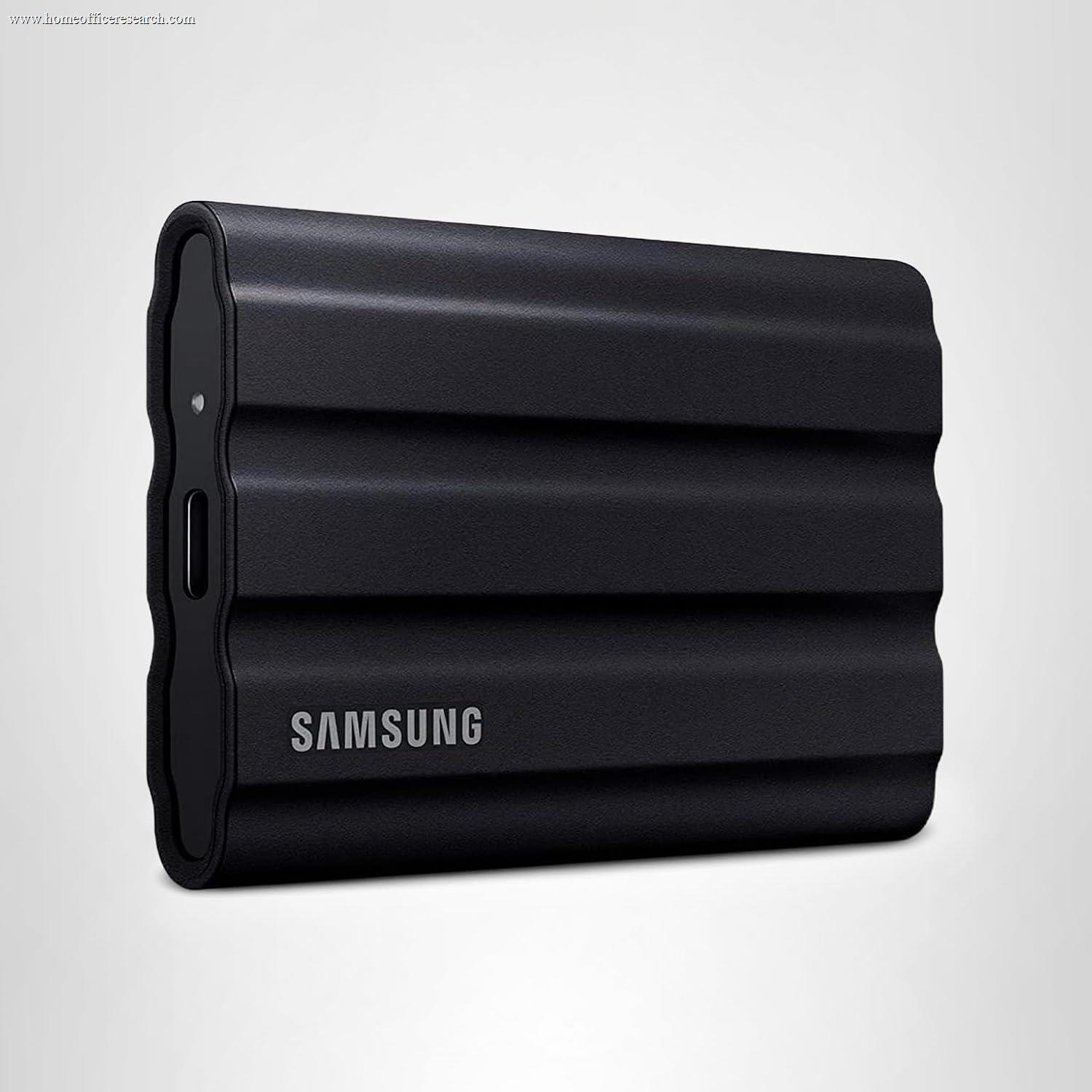
The Samsung T7 Shield is the best everyday portable SSD for a home office and the top pick in our everyday tier. It pairs dependable USB 3.2 Gen 2 speed (up to 1,050 MB/s) with the toughest build in its class — an IP65 dust- and water-resistant, drop-proof rubberized body that doubles as a heatsink to hold speed through long transfers. Add hardware AES-256 encryption and Samsung’s proven reliability, and it’s the drive we’d hand to most people. It isn’t the fastest here — 20 Gbps and Thunderbolt drives leave it behind on paper — and the warranty is three years to Crucial’s five. But for backups, working files, and travel, nothing in the everyday tier balances speed, ruggedness, and trust better.
How We Scored It
Category Deep-Dives
Real-World Performance
7.0 / 10 25% weightingThe T7 Shield runs over USB 3.2 Gen 2 (10 Gbps) and hits its rated 1,050 MB/s read and 1,000 MB/s write in practice — effectively the ceiling of the 10 Gbps interface. For the everyday work this drive is built for — backing up a laptop, carrying project files, offloading photos — that is plenty of speed, and it’s the same real-world number you’ll get from any quality Gen 2 drive.
Where the T7 Shield genuinely separates itself is sustained performance. Its rubberized aluminum body acts as a heatsink, and Samsung’s Dynamic Thermal Guard manages heat so the drive holds its speed during long, large transfers where thinner pocket drives thermally throttle and sag. Independent testing has repeatedly singled out the T7 Shield for unusually flat, consistent write performance rather than the spike-then-collapse pattern common to budget drives. It is DRAM-less — using host memory buffer rather than an onboard cache — but for sequential everyday workloads that’s a non-issue.
We score Performance at 7.0 (the category’s amber band) for one honest reason: this is a 10 Gbps drive. The 20 Gbps Crucial X10 Pro and Samsung T9, and the USB4/Thunderbolt drives higher in our rankings, are simply faster on paper and in raw transfers. The T7 Shield earns its overall standing on everything around raw speed.
Bottom line on performance: Full-speed Gen 2 with class-leading sustained writes thanks to real thermal management. Not the fastest drive here — but one of the most consistent at its interface.
Reliability & Endurance
8.5 / 10 25% weightingReliability shares top weighting in our framework because a drive’s real job is to not lose your data, and the T7 Shield is one of the safest everyday picks. Samsung is vertically integrated — it makes its own 128-layer TLC NAND and controller — and the T7 line has one of the longest, cleanest field-reliability track records among consumer portable SSDs. TLC (rather than cheaper QLC) means better write endurance and more consistent behavior under repeated writes.
The Dynamic Thermal Guard that helps performance also helps longevity: keeping the controller and NAND within their thermal envelope avoids the heat stress that shortens a drive’s life. Hardware AES-256 encryption protects the data if the drive is lost, and Samsung’s firmware and Magician software make health monitoring and updates straightforward.
The one mark against it is the 3-year limited warranty, where Crucial’s X9 Pro and X10 Pro offer five years. That’s a real difference on paper, though Samsung’s reliability reputation and the drive’s rugged construction offset much of the practical risk. As always, no single drive is a backup — keep a second copy regardless of how trustworthy the hardware is.
Bottom line on reliability: In-house TLC NAND, a long clean track record, hardware encryption, and genuine thermal management. Only the shorter 3-year warranty keeps it from a higher mark.
Durability & Build
8.5 / 10 15% weightingThis is the T7 Shield’s signature category and the reason it’s our Best Rugged pick. It carries an IP65 rating — full dust protection and resistance to low-pressure water jets — which is among the best in our everyday tier — matched on ingress protection only by the SanDisk Extreme, and ahead of the IP55-rated Crucial X9 Pro. The grippy rubberized exterior is rated to survive drops of up to 3 meters (9.8 ft), and because SSDs have no moving parts, the practical shock tolerance is higher still.
The build is more than marketing toughness: that elastomer-over-aluminum shell is also the drive’s thermal solution, drawing heat away from the controller so the drive sustains speed under load. It’s a genuinely smart piece of industrial design — ruggedness and performance from the same component — in a compact 98 g package that disappears into a bag.
It loses a little ground only to the IP68, crush-rated field drives higher up our table (the LaCie Rugged SSD Pro5 and SanDisk Pro-G40), which add submersion and vehicle-crush survival — protection most home office users will never need, at several times the price.
Bottom line on durability: IP65 plus a 3 m drop rating make this the toughest everyday drive we tested, and the rugged shell pulls double duty as a heatsink. The practical rugged pick for anyone whose drive leaves the desk.
Connectivity & Compatibility
7.5 / 10 15% weightingThe T7 Shield connects over a single USB-C (USB 3.2 Gen 2) port, and Samsung includes both a USB-C–to–USB-C and a USB-C–to–USB-A cable in the box — a small but genuinely useful touch that means the drive works with older and newer machines out of the gate, without a separate adapter purchase. It’s plug-and-play across Windows, macOS, and Android, and works with game consoles and tablets that accept USB storage.
Because it’s a Gen 2 drive, compatibility is its strength and its ceiling at once: it runs at full speed on essentially any modern USB-C port, with none of the “only-fast-on-the-right-port” caveats of the 20 Gbps Gen 2×2 drives. The flip side is that there’s no extra speed to unlock — plug it into a Thunderbolt or USB4 port and you still get ~1,050 MB/s.
Bottom line on connectivity: Universally compatible at full speed, with both cables included. The trade-off for that simplicity is no headroom beyond 10 Gbps.
Value
8.0 / 10 15% weightingWe judge value within a drive’s performance class, and among everyday Gen 2 drives the T7 Shield is a strong buy. It typically carries a modest premium over the value-leading Crucial X9 Pro, but you’re paying for the best ruggedness in the tier, hardware encryption, and Samsung’s reliability record — a reasonable trade for a drive you’ll lean on daily. It’s available in 1, 2, and 4 TB, and as usual the larger capacities deliver the better price-per-terabyte.
It isn’t the outright cheapest option — the X9 Pro edges it on pure dollars-per-terabyte, and budget drives like the Kingston XS1000 undercut both — but few drives at this price combine this level of durability and trust. (We don’t list prices here because they move constantly; check the current Amazon price before buying.)
Bottom line on value: A small premium over the cheapest Gen 2 drives buys best-in-tier ruggedness, encryption, and reliability. Strong value for a do-everything daily driver.
Software & Security
8.0 / 10 5% weightingThe T7 Shield includes hardware AES-256 encryption, letting you lock the drive with a password that travels with it, independent of the host computer — a meaningful protection for a drive carrying work files that’s easy to misplace. Samsung’s Portable SSD Software and the broader Magician suite (Windows and macOS) handle password setup, firmware updates, and drive-health monitoring in a clean, mature interface that’s a cut above the bundled tools of budget rivals.
This category carries only 5% weight in our framework, because most users rely on OS-level encryption (BitLocker or FileVault) and their own backup routine regardless of the drive. But where it counts, the T7 Shield is among the better-equipped drives in its tier.
Bottom line on software & security: Hardware AES-256 plus genuinely useful cross-platform software. A real, if lightly weighted, advantage over no-frills budget drives.
About the Manufacturer
Samsung is the world’s largest memory manufacturer, and its storage division is vertically integrated in a way few rivals match — it designs and produces its own NAND flash, controllers, and DRAM. That control over the whole stack is a large part of why Samsung SSDs, from the internal 9-series to the portable T-series, have earned a reputation for consistent performance and dependability.
The T7 Shield is the rugged member of the portable T7 family, sitting alongside the standard T7 and the faster, 20 Gbps T9. Samsung positioned it specifically for photographers, videographers, and creators who work outside a controlled office — hence the IP65 rating, drop protection, and the emphasis on sustained rather than just peak speed.
For home office buyers, Samsung’s long field-reliability record and across-the-board hardware encryption are practical reasons it remains one of our most-recommended portable storage brands.